Letter from the Management Board
Scaling impact in a fragmented world
The year 2025 began in a climate of global uncertainty, a defining feature that persisted throughout the year. Conflicts intensified, geopolitical tensions rose, and global alliances continued to shift. Yet despite this turbulence, many FMO’s customers made steady progress and their perseverance enabled FMO to continue supporting inclusive and sustainable prosperity across its markets.
FMO has also welcomed the close ties of some of our customers to Dutch economic interests. Our cocoa clients are a good example: their work is directly connected to the Netherlands’ central role in the global cocoa trade as the world’s largest importer of cocoa. At a time when cocoa prices remain high, investing in cocoa-farmers doesn’t only enable these farmers to become more climate-resilient and protect their livelihood, it also helps to create a more stable supply to Dutch industry and consumers. It is an ecosystem we are proud to support.
Thanks to our partnerships and the strength our customers have shown, we achieved a record year for new investments, reaching €3.9 billion in commitments, surpassing last year’s result (2024: €3.8 billion), and contributing strongly to our Strategy 2030 ambitions. It is also a clear reflection of the trust our partners place in FMO, and of our shared commitment to delivering impact, especially at a time when sustainable finance is more critical than ever.
Financial results
Turning to our financials, FMO reports a net profit of €48 million at year-end, a sharp contrast to the half-year net loss of €90 million. For context, 2024 closed with a net profit of €297 million. This volatility, both within and between years, is primarily driven by the fluctuating euro/US dollar exchange rate. A significant share of our portfolio is denominated in US dollar while we report in euro. Therefore, currency movements can have a substantial impact on our net profit. In 2024, the change in the euro/US dollar exchange rate added more than €100 million to our net profit, whereas in 2025 it reduced our net profit by ~€180 million. Specifically, our equity investment results showed a gain (2025: €112 million vs 2024: €61 million), however, FX result from equity investments resulted in a loss (2025: - €210 million vs 2024: €116 million). We deliberately do not hedge the currency risk for our equity investments, as a weaker dollar also results in a decline of the amount of risk FMO has to report (risk-weighted assets), which in turn supports stability of our capital ratios. This volatility does make us focus mostly on our regular result - from interest income, fees, and dividend payments, minus costs - as the key indicator for managing our operational performance. In 2025, our regular result (€122 million) ended above the level of 2024 (€110 million). At the same time, we experienced only limited cost growth, demonstrating continued cost discipline. This led to an improved cost-to-regular-income ratio compared to 2024 (61 percent in 2025, 63 percent in 2024). It is noteworthy that a large part of our revenues are US dollar denominated, while our expenses are primarily euro denominated, making the improvement in the regular result even more significant. We also maintained a robust Common Equity Tier 1 (CET-1) ratio of 22.2 percent (2024: 20.4 percent). Preserving healthy levels for both ratios remains essential to maximizing our impact and ensuring long-term financial health. To ensure the growth of our expenses does not exceed the growth of our regular income in the years ahead, we will continue to prioritize cost-consciousness and operational efficiency.
Overall, while reported net profit shows a decline due to FX effects, the regular result demonstrates stable underlying performance, supported by higher income and cost discipline.
Impact results
Above all, FMO’s mission is to enable entrepreneurs to increase inclusive and sustainable prosperity. With our investments we aim to support specifically SDG 8 (Decent Work and Economic Growth), SDG 10 (Reduced Inequality) and SDG 13 (Climate Action). In 2025, our total committed portfolio supported an estimated 894 thousand jobs, while our climate-focused investments helped avoid 2,028 ktCo2e greenhouse gas (GHG) emissions.
Our Total Committed Portfolio (TCP) in dollars shows the growth of our overall portfolio: $17.9 billion in 2025 against $16.1 billion in 2024. Reported in euro it stays close to last year’s portfolio: €15.3 billion in 2025 (FMO-A, our own balance sheet: €10.5 billion, public funds: €1.4 billion, mobilized: €3.4 billion), compared to €15.5 billion in 2024 (€10.5 billion, €1.6 billion and €3.4 billion respectively). Strong new investment activity contributed significantly to this result. New investments were financed through FMO’s own balance sheet (€2.7 billion), €229 million from public funds, and €1.0 billion in direct mobilized funds (2024: €2.2 billion, €285 million, and €1.4 billion respectively).
To steer our portfolio on impact, we label investments that contribute to Reduced Inequalities (SDG 10) and Climate Action (SDG 13). Our overall RI-labeled total committed portfolio amounted to €6.7 billion (2024: €6.1 billion), achieving €2.2 billion in RI-labeled new investments in 2025 (2024: €2.3 billion). Also showing growth, our Green-labeled total committed portfolio amounted to €6.2 billion (2024: €5.9 billion), including Green-labeled new investments of €1.8 billion (2024: €1.5 billion).
Sector highlights
To achieve our impact, we support entrepreneurs in three sectors: (1) Agribusiness, Food & Forestry, (2) Energy, and (3) Financial Institutions, allowing us to combine climate action with socio-economic goals. Some of the highlights per sector over 2025 are as follows:
Agribusiness, Food & Forestry: Demonstrating the convening power of FMO, the AFF department brought together leaders from 40 prominent agribusiness companies across Africa, Eurasia, and beyond at the newly launched Cairo Agribusiness Roundtable, co-organized with Rabobank. Discussing climate smart growth, innovative financing, and leadership evolution, the roundtable has laid a foundation for deeper collaboration and shared innovation across the agribusiness sector in emerging economies.
Energy: The Ilute solar project in Zambia underscores how FMO’s financial leadership and sector expertise can mobilize a blended finance package enabling one of Africa’s first project-financed renewable energy plants operating under a market-based offtake structure. The project strengthens Zambia’s energy resilience amid drought-related shortages, while offering a scalable model for private renewable energy investment across the region.
Financial Institutions: Contributing to FMO’s goal to increase investments in Least Developed Countries (LDCs), we supported financial institutions in LDCs with six direct investments, complemented by additional investments towards LDCs through predominantly Africa-focused funds. By utilizing long-term financing, local currency solutions, and capacity development, we help our customers expand access to underserved MSMEs, women entrepreneurs, rural communities, and the bottom 40 percent of income earners.
Next to these highlights, other 2025 milestones are our bi-annual Future of Finance conference held in September in Rotterdam, bringing together over 500 financial leaders from more than 60 countries. We also launched FMO’s new Market Creation Platform to help local organizations overcome systemic barriers in their markets, scale their efforts, and unlock more bankable opportunities. The Platform will implement 4 market creation programs through €70 million in funding. An event was held during the Future of Finance conference to mark this significant achievement, convening donors, philanthropies, DFIs, investors, and local actors, further strengthening our partnerships with Dutch as well as European parties.
We also updated our Independent Complaints Mechanism (ICM) policy, after concluding the public consultation in November. We thank all stakeholders who contributed their time and insights during this process. In June, FMO, our German counterpart DEG, and the communities affected by the Barro Blanco hydro project together reached an agreement, closing the 2014 ICM complaint submitted by the M10 movement and the Cacica General of the Comarca Ngäbe-Buglé.
Regulatory requirements and FMO's role as gatekeeper
This annual report is the second report in which we present our sustainability information under the EU Corporate Sustainability Reporting Directive (CSRD). In 2025, the European Commission adopted targeted amendments to the existing ESRS, clarifying technical requirements and simplifying specific disclosures. FMO has incorporated these changes into its reporting and is closely monitoring further adjustments to anticipate and adapt to any changes that may affect our reporting obligations. Since 2024, FMO set up a bank-wide project for the timely and compliant implementation of the Basel IV standards (CRR3/CRD6 amendments), which required changes in FMO’s internal policies, systems, and processes.
We emphasize the importance of our role as a gatekeeper for the financial system and have, over the past years, invested in further enhancing our risk management framework in relation to financial economic crime. During 2025, DNB reviewed the current state of the framework and concluded that the FMO framework is in line with regulatory requirements.
In August 2023 we reported that, as a result of late notifications of unusual transactions to the Dutch Financial Intelligence Unit (FIU-NL) in 2021 and 2022, the Dutch Central Bank (DNB) decided on enforcement measures. FMO is appealing these administrative measures.
In 2025, FMO continued to strengthen its foundations in data management and cyber security. The outsourcing of our data center enhanced efficiency, scalability, and cyber resilience, while our digitalization program delivered further improvements in the efficiency of our investment process. We also introduced resilience testing supported by rigorous third-party oversight and showed material compliance with the European Digital Operational Resilience Act (DORA). In addition, we advanced the responsible deployment of AI enabled tools, safeguarded by strong data protection measures, to boost productivity and streamline key workflows across the organization.
Changes in Management Board and Supervisory Board
Fatoumata Bouaré was close to ending her second and final term in the Management Board as Chief Finance & Operations Officer (CFOO) and continued her career at the European Bank for Reconstruction and Development (EBRD). In addition, Peter Maila transitioned to Zvilo, a supply chain finance company headquartered in London, leaving a vacancy for the role of Co-Chief Investment Officer (Co-CIO). Our other Co-CIO Huib-Jan de Ruijter assumed his responsibilities, while CEO Michael Jongeneel took on the role of CFOO a.i..
Successors have now been identified for both positions. Drawing on FMO’s own talent, our Director Financial Institutions Juan Jose Dada will take on the role of Co-Chief Investment Officer alongside Huib-Jan, starting May 1st. Idil Kural will join our team as the new Chief Finance & Operations Officer, also starting May 1st. With over 25 years of financial leadership experience in the Netherlands and in Türkiye, Idil joins FMO from ING, where she most recently served as CFO for Wholesale Banking EMEA. Both appointments strengthen the diversity of expertise and backgrounds within our Management Board. We look forward to working together in the years ahead.
During the Annual General Meeting of shareholders on 23 April 2025, Rob Becker was appointed chair of FMO’s Supervisory Board, taking over from Dirk Jan van den Berg, who stepped down from the Supervisory Board after concluding his second and final term. At the upcoming AGM in April, we will also say goodbye to Koos Timmermans, chair of the Audit and Risk Committee, who served on the Supervisory Board for 8.5 years. We thank Koos for his valuable contributions to FMO over the past years. We will miss his collegial and constructive approach, as well as his remarkable ability to simplify complex issues. His successor will be introduced to the AGM also this April.
Looking ahead
The impact of an increasingly volatile geopolitical environment – amplified by the escalating conflict in the Middle East and its consequences outside the region – combined with high fluctuations in FX-rates, and the influence of AI, are reshaping the environment in which FMO operates. Against that backdrop, we are undertaking a midterm review of our 2030 Strategy: Pioneer–Develop–Scale. Not because our ambitions have changed, but because we consider it prudent, especially in light of the pace and scale of global transformation, to reflect and ensure our strategic direction remains both relevant and resilient.
While 2026 is bringing its share of challenges, it strongly calls for clarity of purpose and continued, steady commitment. We will stay focused on maximizing our impact, strengthening our partnerships, and supporting markets and customers to navigate uncertainty. As always, our ability to do so depends on the dedication and professionalism of our colleagues across FMO. We want to express our sincere appreciation for their hard work and steadfast commitment to our mission: thank you for everything you have done, and continue to do, to make our impact possible.
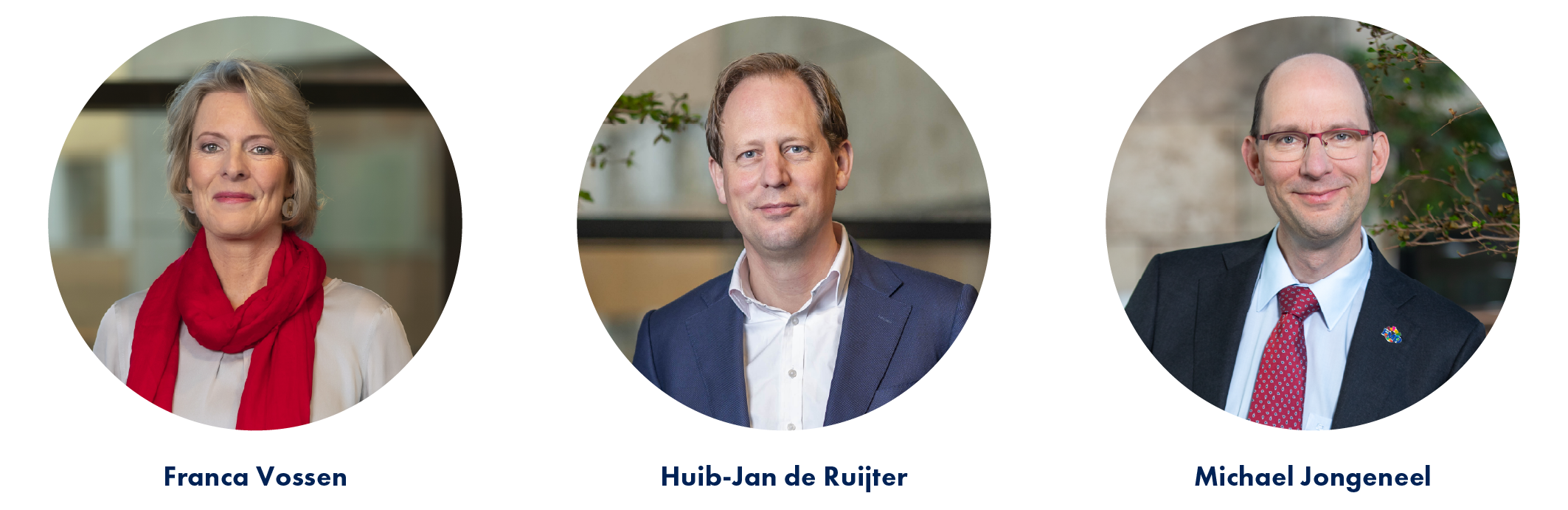
Franca Vossen, Chief Risk Officer
Huib-Jan de Ruijter, Co-Chief Investment Officer
Michael Jongeneel, Chief Executive Officer, Chief Finance & Operations Officer a.i.