ESRS 2 Strategy, business model and value chain
FMO supports sustainable private sector growth in emerging markets and developing economies by investing in ambitious businesses and projects.
We invest in 75 countries across four regions: Africa, Asia, Europe and Central Asia, and Latin America and the Caribbean. We focus on emerging markets and developing economies which are often perceived as too risky by commercial actors. Our customers operate in environments that can be more susceptible to institutional and political instability, commodity price and foreign exchange fluctuations, as well as natural disasters and conflicts. To support them effectively, we engage with them throughout the investment process to understand their unique risks and tailor our products accordingly. This approach helps our customers enhance their ESG practices, aimed at creating meaningful impact and fostering sustainable change.
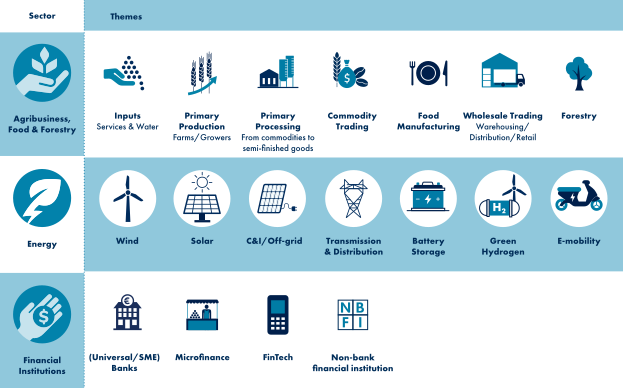
FMO focuses on three key sectors: Agribusiness, Food & Forestry, Energy, and Financial Institutions. We also finance other sectors indirectly through our investments in financial institutions (FIs) and private equity (PE) funds. By concentrating our efforts in these areas, we take a leading role, build strong relationships, and contribute to such SDGs as promoting Decent Work and Economic Growth (SDG 8), Reduced Inequalities (SDG 10), and Climate Action (SDG 13).
Figure 1. The sectors and customer segments we focus on
Our business model
Through our core business activities and interactions with others, FMO transforms resources into outputs that, over the short, medium, and long-term can create value for the organization, its stakeholders, the local society, and the environment. By offering and creating financing solutions, supporting our customers with technical assistance and capacity development, and helping customers enhance their capabilities around sustainability-related matters, we aim to move investment opportunities from market creation and public funds, through our own balance sheet, to commercial mobilization. Our core business activities are described in the following sections.
Our Resources
To deliver on our strategic ambitions, FMO relies on specific capabilities, resources, and inputs. Most notably people and needed skillsets, networks and partnerships and financial resources.
People
-
Employee numbers and diversity have been growing in line with our strategy to enable portfolio growth, new strategic focus areas (e.g., market creation) and the increasing complexity and regulatory requirements. In the future, the growth in employee numbers is expected to tail off. The total number of employees is included in the sub-chapter 'S1 Own workforce'.
-
We will continue to improve our ability to attract, hire, on-board, train, develop and retain employees while ensuring that employee wellbeing remains a key focus.
-
Strategic workforce and succession planning are needed to have a multi-year view on required employee skills and capacity.
New skillsets
-
We need to continue developing new skillsets through hiring, training and/or forming external partnerships to support, for example market creation, investing in fragile states, deal sourcing, ESG risk assessment, customer advisory, data analytics, agile project management, etc. This will require further strengthening of FMO’s learning & development programs and tools.
-
Leadership need to stimulate the right behaviors and develop their own skillsets in line with the envisioned scaling and diversity of FMO staff.
Network and partnerships
FMO cannot achieve its strategic ambitions alone. We rely on partners and other stakeholders to secure funding, innovate and create new offerings, support market creation, engage with local communities, and develop new skillsets. As the number and diversity of these relationships grows, FMO needs to be able to adapt and manage multifaceted, complex relationships in the most effective way.
Financial
FMO benefits from a solid financial foundation with a healthy net interest margin, supported by its strong capital base, and has similar credit ratings, AAA, to the Dutch Government. The relationship with the Dutch State covers three pillars: the Support Agreement, ownership structure, and government funds. The Support Agreement reaffirms the vital role that FMO plays in Dutch government policy, the State’s intention to ensure FMO’s continuity in accordance with the Agreement and to facilitate FMO’s stable access to capital market funding in order to effectively carry out its mandate.
Products and services
Through the following business activities and interactions with others, FMO transforms resources into outputs that, over the short-, medium- and long-term, create value for the organization, its stakeholders, local society, and the environment.
1. We provide financing
We finance and support proven business models. This is the core of our operations. It is where we provide bankable businesses and projects, for example loans, equity investments, guarantees and development contributions. We offer long-term finance and, where possible, provided in local currencies to mitigate the exchange rate risk of our customers. This includes:
-
Offering direct medium- and long-term loans at both fixed and variable interest rates, with a repayment grace period where needed.
-
Investing equity directly or indirectly (through private equity funds) or investing alongside partners. We provide stable, long-term capital and intend to sell our stake after five to ten years. We receive dividends and account for fair value gains or losses during the lifetime of an investment.
-
Structuring guarantees that meet the needs of the (end) beneficiary, the market, and the targeted creditors.
2. We blend and mobilize finance
We make high-impact and high-risk investments possible by leveraging public funding to support entrepreneurs working on new business models or operating in low-income countries. This includes:
-
Deploying - on behalf of governments and multilateral organizations - public finance in higher-risk projects. Such finance helps to reduce and share risks. Private and institutional capital will then be more easily attracted towards scalable but higher-risk investments that otherwise would not have been considered by commercial investors.
-
Arranging syndicated loans by bringing together commercial banks, investors, and other DFIs. Commercial investors have access to FMO’s expertise in impact investing in emerging markets and developing economies.
-
Through FMO Investment Management, providing services to several funds with different market-based, risk-return profiles to accommodate different investor risk appetites. FMO receives a fee for providing these services.
3. We (help others to) innovate
We aim to make unbankable opportunities bankable; through business development, and by developing ecosystems that seed and nurture nascent segments and businesses. We do this by means of collaboration and partnerships. This includes:
-
Fostering innovation by encouraging and participating in the evolution of new approaches, business models, and products that possess the potential for heightened impact and scalability.
-
Enabling market ecosystem development and strengthening customer business development through strategic collaborations with partners.
4. We actively promote impact and ESG standards
Our services also include advisory support and technical assistance, aimed at assisting customers in establishing sustainable and profitable enterprises. This encompasses guidance in designing and implementing ESG risk mitigation measures, conducting master classes and events, facilitating capacity development, and spearheading sector initiatives.
Long-term outcomes
FMO believes in a world in which, in 2050, more than 9 billion people live well, within planetary boundaries. In order to achieve this, FMO aims to maximize its contribution towards the SDGs while minimizing the negative impacts that may occur as a result of its activities.
FMO's approach involves generating intentional, positive development impact through its investment portfolio. This is in line with our mandate and strategic objectives.
FMO has identified the following long-term impact and sustainability-related outcomes that we believe our activities can contribute to:
-
A more inclusive, resilient, responsible and sustainable private sector.
-
Improved livelihoods, including for people in the bottom 40 percent of income distribution, increased gender equality and poverty reduced.
-
A transition towards low-carbon and climate resilient economies in a just and inclusive way and protecting and promoting biodiversity.
However, we recognize that our activities may also result in unintended impacts - impacts we do not deliberately seek to generate, but which may affect society or the environment. Hence, we aim to minimize the potential negative impacts that may occur as a result of our activities through ESG performance management. Furthermore, FMO also integrates ESG in its own operations.
A more inclusive, resilient, responsible and sustainable private sector
To contribute towards a more inclusive private sector, we invest in countries where other investors perceive risks as too high, including least developed countries (LDCs) and fragile states. In addition, we encourage our FI customers to increase access to finance to marginalized groups, particularly women. By providing finance and expertise, we aim to support customer resilience during economic downturns, as well as navigate the adverse impacts of climate change and other uncertainties. We intend to help our customers to be more responsible and sustainable by supporting the implementation of (improved) ESG risk identification and management and the adoption of responsible business practices within their operations. We believe these activities lead to more robust and resilient customer operations, which in turn enables them to attract additional (commercial) capital and further grow their businesses. Furthermore, we support business ideas that have not yet matured to a commercial phase and strengthen private sector ecosystems.
Improved livelihoods, including for people in the bottom 40 percent of income distribution, increased gender equality and poverty reduced
We focus on three areas to improve the livelihoods of the people in our markets. First, we invest in increased access to goods and services–such as food, finance, and electricity–thereby facilitating income-generating opportunities. Second, we support our customers in growing and/or sustaining the number of jobs in their own businesses as well as the wider economy, and encourage them to improve the quality and inclusiveness of those jobs. Third, by investing in climate adaptation and resilience, we aim to protect and strengthen livelihoods from the adverse impacts of climate change. We believe our approach can be particularly beneficial to the most vulnerable groups such as women and people belonging to the bottom 40 percent of income distribution.
A transition towards low-carbon and climate resilient economies in a just and inclusive way and protecting and promoting biodiversity
Climate change poses a threat to people’s livelihoods and wider efforts to meet the SDGs. For this reason, we aim to contribute to a just and inclusive transition towards low-carbon and climate-resilient economies. We focus on reducing the environmental footprint of our customers and their value chains through energy solutions, agriculture, forestry, and customer engagement. In addition, we target investments in climate adaptation and resilience to support our customers to mitigate physical climate risk and reduce the impact of climate change on their activities. Through our ESG activities, we work with our customers to improve risk management practices, recognizing the linkages between climate, environment, and social risks.
Minimizing negative impact
We recognize that our activities and the projects in which we invest may result in unintended negative impacts on people and the planet - impacts we do not deliberately seek to generate but which may affect society or the environment. We identify and manage these unintended impacts through our ESG management processes. For example, whilst a hydro power investment can provide clean energy, support economic growth, and improve lives overall, it may also require the resettlement of surrounding communities. In such cases, we would require the customer to put safeguards in place including a grievance mechanism, and to respond to community concerns. The ESG standards we expect our customers to apply are intended to identify, evaluate and mitigate key environmental and social (E&S) risks as well as the negative impact of their activities.
FMO’s own operations
As an organization, FMO is required to comply with applicable laws and regulations, including Dutch and European law, as well as the Dutch Corporate Governance Code and Dutch Banking Code. With regards to the Dutch Corporate Governance Code and Dutch Banking Code, FMO complies or will otherwise explain where we diverge from these codes. FMO believes in diversity, and embraces and promotes this within its recruitment, career management and management development. This topic is further addressed in section 'S1-5 Targets'. FMO strives to remain climate-neutral in all its operational activities, through energy efficiency, compensation, and sustainable energy production. In its supply chain, FMO pays particular attention to the terms and conditions of employment of the contractors working in its offices and to minimizing the environmental impact of the food supplied in FMO’s offices. FMO provides healthy and organic food to FMO’s employees. FMO informs employees regularly on external and internal results from ESG and sustainability-related efforts and provides regular staff training on its Sustainability Policy and on specific ESG issues and processes. Further information on this topic is provided in section 'S1-13 Training and skills development metrics'.
Main features of FMO’s value chain
As a DFI, the most material impacts, risks and opportunities occur through our investments by financing and engaging with our customers in the downstream value chain. We invest in customers that operate within FMO’s strategic sectors.
In turn, FMO’s customers have their own operations and value chains that have different impacts in the areas and local context in which they operate, affecting both people (end-users, beneficiaries, local communities) and the environment (climate and nature). A description of the type of customers we serve is included in the 'Report of the Management Board' in the sub-chapter 'Our strategy'.
Our own operations revolve around identifying potential investment opportunities (customer relationships), determining their sustainability-related impacts and risks, securing funding, and establishing contracts and agreements with customers. Additionally, our operations include providing loans, guarantees, equity and technical assistance to our customers (our financing products), monitoring the portfolio's health (credit risk, impact, customer satisfaction, and compliance), and managing the overall investment lifecycle. Enabling activities to support our core operations include strategy setting, product management, policy and compliance definition, risk management, external reporting, sustainability and impact management, and various corporate functions like IT, finance, procurement as well as human resources as FMO acts as an international employer to the people that work for our organization.
We need upstream shareholders and public and private investors to provide capital as well as key partners and key suppliers to support us in our business model. Our upstream value chain activities are, therefore, focused on attracting and mobilizing funds and capital to scale up our development impact. We use public funds to de-risk investments and to be able to attract private capital. We bring in commercial investors through syndicated loans or fund management. Our public investment partners include: the Dutch Government, the UK Government, the EC and the Green Climate Fund (GCF). Mobilization activities include loan syndications, participations by several private debt funds that FMO Investment Management (FMO IM) advises for and through unfunded risk participations by commercial parties such as commercial banks. In addition, we work with suppliers that provide goods and services. We only want to work with trustworthy suppliers and have put in place a due diligence process in line with the Dutch Anti-Money Laundering and Anti-Terrorist Financing Act (Wwft). This process applies to new or existing suppliers related to our main activities, such as consultants, legal advisors, government intermediaries, and/or providers of critically outsourced services. This is set out in FMO’s Procurement and Outsourcing Policy.
ESRS 2 Interests and views of stakeholders
FMO is committed to taking into account the relevant interests of its stakeholders. Close dialogue with our stakeholders is an integral and natural part of our operations. We see stakeholder engagement as a two-way dialogue. Our external stakeholders challenge us to improve, bring diverse perspectives, and be transparent and accountable. They help us reflect on and enhance key practices, such as our financial performance, ESG risk assessment, and impact management. Overall, stakeholder engagement helps us strengthen the quality of our decision-making.
It is important for us to engage with our stakeholders timely, openly, transparently, and constructively. We actively engage with our external stakeholders to create partnerships, harmonize approaches, exchange knowledge, and seek insights that inform and help shape our policies and approaches.
FMO stakeholders and stakeholder management
Our customers, the State of the Netherlands, shareholders, employees, investors, NGOs, supervisors, other DFIs/IFIs and regulators are among our most important stakeholders. Engagement can take various forms, from day-to-day, business-as-usual engagement to more strategic and planned engagements, such as regular meetings, surveys, forums, and stakeholder dialogues. For more information on stakeholder engagement, see our Position Statement on Corporate Stakeholder Engagement & Lobbying available on the FMO website.
FMO distinguishes between three stakeholder groups:
-
External (investment-specific) stakeholders: Customers, local communities, and employees employed by our customers as well as other (positively/negatively) affected individuals. The relationships with our customers are managed by FMO’s investment teams, including ESG and impact specialists.
-
Business Stakeholders: Our customers, investors, donors, suppliers, business partners, and employees.
-
Corporate stakeholder groups:
-
The Dutch State in its role as policy and lawmaker.
-
The EU and its institutions in their role as policy and lawmakers and creators of regulations.
-
Political parties, members of parliament, and politicians.
-
Non-governmental organizations, community-based organizations, think tanks, universities, and relevant experts.
-
The media, media representatives, and opinion leaders.
-
Policies
FMO believes that transparency and accountability in its financing and investments are fundamental to fulfilling its development mandate. It allows us to improve our investment decisions and helps us be transparent to our stakeholders about whether FMO is achieving what it intends.
To facilitate this, FMO adheres to a Customer Disclosure Policy, outlining the scope and type of information that it makes available to the public. In addition to the disclosure of its annual reports, press releases and corporate- and policy-related disclosure, FMO also discloses selected relevant information about its investments and financing, both prior to (explicitly inviting comments from the stakeholder community), and after contracting.
Table 3. Minimum disclosure requirements for Customer Disclosure Policy
|
Scope of policy |
All investments involving FMO debt and equity transactions |
|
Accountable body |
Management Board |
|
Third-party standards/initiatives (if relevant) |
International Finance Corporation Performance Standards (IFC PS), European Development Finance Institutions' (EDFI) Principles for Responsible Financing of Sustainable development |
|
Consideration to interests of key stakeholders (if relevant) |
Stakeholders are invited to provide comments on our investments, prior to and after contracting |
|
Availability to stakeholders (if relevant) |
Customer Disclosure Policy is publicly available on our website |
As a DFI, we are sensitive to the social context and environment in which we are active. The businesses and projects we invest in have an important impact on local communities and society at large. Therefore, we integrate stakeholder considerations and information, based on consultation with stakeholders (including affected communities, in line with the IFC PS), into our investment decision-making, and we monitor whether decisions will further contribute to the quality and positive impact of FMO’s investments, and also ensure community support. For more information, see our Sustainability Policy.
FMO makes a distinction between project-related complaints and general complaints. General complaints can be communicated in writing. For project-related complaints, FMO has implemented an Independent Complaints Mechanism (ICM) and accompanying procedures. For further information, please refer to the ICM on the FMO website. The ICM ensures the right to be heard for complainants who feel affected by an FMO-financed operation, facilitating dispute resolution, and assisting FMO in drawing lessons learned. The ICM Policy describes the structure and governance of the complaints procedure, which allows affected external parties to file a complaint concerning a project financed by FMO. For more information on the project-related complaints procedure, refer to 'S2-3 Processes to remediate negative impacts and channels to raise concerns'.
Table 4. Minimum disclosure requirements for Independent Complaints Mechanism Policy
|
Scope of policy |
The mechanism applies to FMO-financed operations |
|
Accountable body |
Management Board |
|
Third-party standards/initiatives (if relevant) |
IFC PS, the UN Guiding Principles on Business and Human Rights and the OECD Guidelines for Multinational Enterprises |
|
Consideration to interests of key stakeholders (if relevant) |
Following the completion of the draft policy, we initiated a public consultation process and invited stakeholders to share their views. Their feedback will be incorporated into the final version of the policy. |
|
Availability to stakeholders (if relevant) |
ICM policy can be found publicly on our website |
FMO reports on the number of admissible complaints received through the ICM. Details of this entity-specific metric and results are included in the following table.
Table 5. Minimum disclosure requirements for metrics: new admissible complaints received
|
Methodology and assumptions |
Number of complaints filed with the ICM that were declared admissible by the Independent Expert Panel (IEP) are defined as 'New admissible complaints received'. |
|
Validation by external body other than the assurance provider (if applicable) |
N/A |
|
Unit |
Number |
|
2025 |
0 admissible complaints |
|
2024 |
0 admissible complaints |
Stakeholder engagement and outcomes
We are in constant dialogue with various stakeholders. Throughout the years, at a corporate level we have taken the outcomes of stakeholder engagement into account in, among other things:
-
FMO’s strategy development (2030 Strategy: Pioneer-Develop-Scale)
-
FMO’s double materiality assessment
-
FMO’s Sustainability Policy
-
FMO’s position statements
-
FMO’s Customer Disclosure Policy
-
The Independent Complaints Mechanism (policy update)
-
FMO’s Climate Action Plan (CAP)
During the development of our long-term 2030 Strategy Pioneer – Develop – Scale we consulted internal stakeholders (including FMO’s employees) and external stakeholders. For this consultation, meetings were held with the Dutch Ministry of Finance, Dutch Ministry of Foreign Affairs, Dutch Central Bank (DNB), NGOs, (E)DFIs, private banks, commercial finance partners, and the European Commission. At the start of the strategic development process, FMO collected the key topics and expectations of these stakeholders, which was part of the foundation for the further development of the long-term strategy. The Dutch Ministries of Foreign Affairs and Finance provided their vision during various stages of the strategy development process.
During the materiality assessment, FMO takes the views and interests of stakeholders into account. We do this either by consulting them directly or integrating knowledge about stakeholder interests coming out of regular stakeholder engagement activities as described in this section.
When developing or updating policy statements or key impact policies, we invite stakeholders to give their views on new policies and position statements that guide our investment process and decision-making. For example, in 2025, FMO, DEG (the German Investment and Development Corporation), and Proparco initiated a review of the Independent Complaint Mechanism Policy, giving a broad range of FMO, DEG, and Proparco stakeholders the opportunity to give their opinion, which will be used to further improve the policy.
At an investment level, the outcomes of stakeholder engagement are taken into account via our due diligence process. Stakeholder and community engagement is a key principle embedded within the IFC PS. This means that FMO is committed to actively engaging with affected stakeholders and local communities throughout the project lifecycle in order to understand their concerns, incorporate their perspectives into decision-making processes, and mitigate any negative impacts on them. On an ad-hoc basis, FMO also engages with value chain workers as part of its monitoring. For more information refer to section 'ESRS 2 - IRO management' and specific information on this type of stakeholder engagement in the sections 'S2-2 Processes for engaging with value chain workers', 'S3-2 Processes for engaging with affected communities' and 'S4-2 Processes for engaging with consumers and end-users'.
The Integrity and Issue Management Committee (IIMC) is a sub-committee of the Non-Financial Risk Committee (NFRC) and is appointed by the Management Board. The purpose and scope of the IIMC is as follows:
-
The Committee contributes FMO’s governance framework by ensuring that reputational, compliance and integrity considerations are systematically integrated into decision-making, ensuring that reputational, compliance and integrity considerations are systematically integrated into decision-making.
-
The Committee protects FMO against regulatory scrutiny and reputational damage related to, among others, financial, integrity and stakeholder-related matters.
-
Additionally, the Committee serves as a decision-making and escalation forum for investment teams and Special Operations and includes various perspectives on issues that require careful assessment. In doing so, the IIMC complements existing risk management and control functions, and supports the organization in navigating complex dilemmas in a transparent and accountable manner.
The Management Board is informed of the views and interests of FMO project affected stakeholders on a case-by-case basis and the Supervisory Board (through the Management Board) via periodic briefs. For example, when there is a material impact voiced via 1) ex-ante (prior to commitment) disclosure questions; 2) NGO questions; or 3) (ongoing) complaints with the ICM.
FMO regularly conducts employee surveys to gauge employee satisfaction and engagement levels. For more information on how we engage with our employees please refer to the sub-chapter 'S1 - Own Workforce'.
Future steps towards our stakeholder dialogues
In 2025, we published the position Statement on Corporate Stakeholder Engagement & Lobbying. Prior to publication, the statement has been submitted for stakeholder consultation. The Position Statements explain FMO’s choices in relation to major global sustainability issues and further explain how we select investments, work with customers and other stakeholders, and monitor performance. They reflect our objective to apply the highest possible standard of ethics and integrity to our business activities.
The ICM Policy is in its final draft stage. To support the public consultation process, an external provider has developed a platform that enables stakeholders and NGOs to submit feedback via questionnaires and email. These responses are being reviewed during public consultation events including webinars and in-person meetings. Following the completion of public consultation, inputs received during the process will be incorporated into the draft policy, which will then be finalized. The public consultation aims to enhance and clarify the policy, while also fostering stakeholder trust and buy-in.