Financial risk
Credit risk
Definition
Credit risk is defined as the risk that the bank will suffer an economic loss because a customer fails to meet its obligations in accordance with agreed terms.
Risk appetite and governance
Adverse changes in credit quality can develop within FMO’s emerging market loan portfolio due to specific customer and product risks, or risks relating to the country in which the customer conducts its business. The main source of credit risk arises from investments in emerging markets and off-balance instruments such as loan commitments and guarantees.
Credit risk management is important when selecting and monitoring investments. In this process, a set of investment criteria per sector and product is used that reflects minimum standards for the required financial strength of FMO’s customers. This is further supported by credit risk models that are used for risk quantification, calculations of expected credit loss allowance, and the determination of economic capital use per transaction. Funding decisions depend on the risk profile of the customer and financing instrument. As part of regular credit monitoring, FMO customers are subject to annual reviews at a minimum. Customers that are identified as having financial difficulties fall under an intensified monitoring regime to proactively manage loans before they become non-performing, including semi-annual reviews. Additionally, portfolio movements and trends are discussed and analysed during the quarterly portfolio monitoring meetings. The Special Operations department is responsible for actively managing the restructuring of distressed assets.
FMO has set internal appetite levels for non-performing exposures and specific impairments on loans. If any of the metrics exceed the appetite levels, the Credit department will assess the underlying movements and analyze trends per sector, geography, and any other relevant parameter. The Credit department will also consider market developments and peer group benchmarks. Based on the analysis, it will propose mitigating measures to the FRC. If any of the indicators deteriorate further, the Risk department will be involved to assess to what extent the trend is threatening FMO’s capital and liquidity ratios.
The Credit Risk Metrics were within risk appetite during 2025.
Exposures and credit scoring
The following table shows FMO's total gross exposure to credit risk at year-end. The exposures, including derivatives, are shown gross, before impairments and the effect of mitigation using third-party guarantees, master netting, or collateral agreements. Regarding derivative financial instruments, only the ones with positive market values are presented. The maximum exposure to credit risk increased during the year to €10.2 billion at year-end 2025 (2024: €9.8 billion).
|
Maximum exposure to credit risk, including derivatives (€ x 1,000) |
2025 |
2024 |
|
On-balance |
||
|
Cash balances with Banks |
140,239 |
43,096 |
|
Current accounts with State funds and other programs |
3,207 |
1,336 |
|
Short-term deposits |
||
|
-of which: amortized cost |
623,999 |
1,111,886 |
|
-of which: fair value through profit or loss |
446,130 |
369,481 |
|
Other receivables |
33,487 |
18,393 |
|
Interest-bearing securities |
||
|
-of which: amortized cost |
573,221 |
481,858 |
|
-of which: fair value through profit or loss |
134,120 |
107,596 |
|
Derivative financial instruments |
233,483 |
126,339 |
|
Loans to the private sector |
||
|
-of which: amortized cost |
5,829,129 |
5,443,421 |
|
-of which: fair value through profit or loss |
742,085 |
686,588 |
|
Current tax receivables |
893 |
13,297 |
|
Total on-balance |
8,759,993 |
8,403,291 |
|
Off-balance |
||
|
Contingent liabilities (guarantees issued) |
218,713 |
193,176 |
|
Irrevocable facilities (loans and financial guarantee commitments) |
1,189,750 |
1,186,725 |
|
Total off-balance |
1,408,463 |
1,379,901 |
|
Total credit risk exposure |
10,168,456 |
9,783,192 |
When measuring the credit risk of the emerging market portfolio at customer level, the main parameters used are the credit quality of the counterparties and the expected recovery ratio in case of defaults. Credit quality is measured by scoring customers on various financial and key performance indicators. FMO uses its own credit scoring methodology. The model follows the European Banking Authority (EBA) guidelines regarding the appropriate treatment of a low default portfolio and uses an alternative for statistical validation to perform the risk assessment of the models when there is limited or no default data.
The credit scoring models are based on quantitative and qualitative factors and are different for respective customer types. The models for banks and non-banking financial institutions use factors including the financial strength of the customer, franchise value, and the market and regulatory environment. The model for corporates uses factors including financial ratios, governance, and strategy. The project finance model uses factors such as transaction characteristics, market conditions, political and legal environment, and financial strength of the borrower.
Based on these scores, FMO assigns ratings to each customer on an internal scale from F1 (lowest risk) to F20 (default) representing the probability of default. This rating system is equivalent to the credit quality rating scale applied by Moody's and S&P. Likewise, the loss given default is assigned by scoring various dimensions of the product specific risk and incorporating customer characteristics. The probability of default and loss given default scores are also used as parameters in the IFRS9 expected credit loss model. Please refer to the 'Material accounting policies' section, for details of the expected credit loss calculation methodology.
The majority of FMO's gross loan portfolio (68 percent) remains in the F11 to F16 ratings categories.
Credit quality analysis
FMO is exposed to on-balance positions including loans which carry credit risk. The following table shows the credit quality and the exposure to credit risk of the on-balance loan positions for the period.
|
2025 |
||||||
|
Financial instruments at amortised cost |
Financial instruments at fair value |
|||||
|
Indicative counterparty credit rating scale of S&P (€ x 1,000) |
Stage 1 |
Stage 2 |
Stage 3 |
Fair value |
Total |
% |
|
F1-F10 (BBB- and higher) |
1,332,052 |
- |
- |
118,819 |
1,450,871 |
22% |
|
F11-F13 (BB-,BB,BB+) |
2,482,035 |
31,156 |
- |
430,941 |
2,944,132 |
45% |
|
F14-F16 (B-,B,B+) |
1,196,108 |
177,114 |
- |
139,370 |
1,512,592 |
23% |
|
F17-F19 (CCC,CCC+, CCC-) |
24,579 |
268,818 |
- |
5,907 |
299,304 |
5% |
|
F20 (CC) |
- |
- |
317,241 |
47,048 |
364,289 |
5% |
|
Gross exposure |
5,034,774 |
477,088 |
317,241 |
742,085 |
6,571,188 |
100% |
|
Less: amortizable fees |
-43,960 |
-4,245 |
-1,881 |
- |
-50,086 |
|
|
Less: ECL allowance |
-21,832 |
-20,061 |
-132,509 |
- |
-174,402 |
|
|
Plus: FV adjustments |
- |
- |
- |
-32,385 |
-32,385 |
|
|
Carrying amount |
4,968,982 |
452,782 |
182,851 |
709,700 |
6,314,315 |
|
|
2024 |
||||||
|
Financial instruments at amortised cost |
Financial instruments at fair value |
|||||
|
Indicative counterparty credit rating scale of S&P (€ x 1,000) |
Stage 1 |
Stage 2 |
Stage 3 |
Fair value |
Total |
% |
|
F1-F10 (BBB- and higher) |
1,027,684 |
- |
- |
40,097 |
1,067,781 |
17% |
|
F11-F13 (BB-,BB,BB+) |
2,206,347 |
7,293 |
- |
429,664 |
2,643,304 |
43% |
|
F14-F16 (B-,B,B+) |
1,077,219 |
133,435 |
- |
129,572 |
1,340,226 |
22% |
|
F17-F19 (CCC,CCC+, CCC-) |
169,094 |
476,569 |
- |
9,929 |
655,592 |
11% |
|
F20 (CC) |
- |
- |
345,772 |
82,415 |
428,187 |
7% |
|
Gross exposure |
4,480,344 |
617,297 |
345,772 |
691,677 |
6,135,090 |
100% |
|
Less: amortizable fees |
-38,701 |
-5,674 |
-2,337 |
- |
-46,712 |
|
|
Less: ECL allowance |
-30,723 |
-31,694 |
-143,766 |
- |
-206,183 |
|
|
Plus: FV adjustments |
- |
- |
- |
-39,616 |
-39,616 |
|
|
Carrying amount |
4,410,920 |
579,929 |
199,669 |
652,061 |
5,842,579 |
|
In addition to its on-balance finance activities, FMO is also exposed to off-balance credit-related commitments. Guarantees, which represent contingent liabilities to make payments if a customer cannot meet its obligations to third parties, carry similar credit risks as loans. Most of the guarantees denominated in US dollars. Guarantees on export facilities are collateralized by the underlying letters of credit, and therefore carry less credit risk than direct uncollateralized borrowing. The following table shows the credit quality and the exposure to credit risk of the financial guarantees for the period.
|
2025 |
||||
|
Indicative counterparty credit rating scale of S&P (€ x 1,000) |
Stage 1 |
Stage 2 |
Stage 3 |
Total |
|
F1-F10 (BBB- and higher) |
92,794 |
- |
- |
92,794 |
|
F11-F13 (BB-,BB,BB+) |
160,299 |
- |
- |
160,299 |
|
F14-F16 (B-,B,B+) |
29,837 |
25,138 |
- |
54,975 |
|
F17-F19 (CCC,CCC+, CCC-) |
7,459 |
15,091 |
- |
22,550 |
|
F20 (CC) |
3,337 |
- |
3,877 |
7,214 |
|
Gross exposure |
293,726 |
40,229 |
3,877 |
337,832 |
|
ECL allowance |
-250 |
-1,143 |
-533 |
-1,926 |
|
Net exposure |
293,476 |
39,086 |
3,344 |
335,906 |
|
2024 |
||||
|
Indicative counterparty credit rating scale of S&P (€ x 1,000) |
Stage 1 |
Stage 2 |
Stage 3 |
Total |
|
F1-F10 (BBB- and higher) |
50,037 |
- |
- |
50,037 |
|
F11-F13 (BB-,BB,BB+) |
293,199 |
- |
- |
293,199 |
|
F14-F16 (B-,B,B+) |
12,238 |
28,502 |
- |
40,740 |
|
F17-F19 (CCC,CCC+, CCC-) |
45,702 |
2,117 |
- |
47,819 |
|
F20 (CC) |
- |
- |
24,553 |
24,553 |
|
Gross exposure |
401,176 |
30,619 |
24,553 |
456,348 |
|
ECL allowance |
-1,137 |
-296 |
-1,386 |
-2,819 |
|
Net exposure |
400,039 |
30,323 |
23,167 |
453,529 |
Financial guarantees represent €219 million (2024: €193 million) classified as contingent liabilities and €119 million (2024: €263 million) classified as irrevocable facilities.
Additionally, irrevocable facilities represent commitments to extend finance to customers and consist of contracts signed but not disbursed, which are usually not immediately and fully drawn.
The following table shows the credit quality and the exposure to credit risk of the loan commitments to the private sector of contracts signed but not yet disbursed.
|
2025 |
|||||
|
Indicative counterparty credit rating scale of S&P (€ x 1,000) |
Stage 1 |
Stage 2 |
Stage 3 |
Other |
Total |
|
F1-F10 (BBB- and higher) |
115,990 |
- |
- |
42,608 |
158,598 |
|
F11-F13 (BB-,BB,BB+) |
433,540 |
8,522 |
- |
30,451 |
472,513 |
|
F14-F16 (B-,B,B+) |
315,010 |
46,384 |
- |
1,544 |
362,938 |
|
F17-F19 (CCC,CCC+, CCC-) |
- |
62,394 |
- |
- |
62,394 |
|
F20 (CC) |
- |
- |
14,187 |
- |
14,187 |
|
Gross exposure |
864,540 |
117,300 |
14,187 |
74,603 |
1,070,630 |
|
ECL allowance |
-3,113 |
-6,586 |
-576 |
- |
-10,275 |
|
Net exposure |
861,427 |
110,714 |
13,611 |
74,603 |
1,060,355 |
|
2024 |
|||||
|
Indicative counterparty credit rating scale of S&P (€ x 1,000) |
Stage 1 |
Stage 2 |
Stage 3 |
Other |
Total |
|
F1-F10 (BBB- and higher) |
23,094 |
- |
- |
140,096 |
163,190 |
|
F11-F13 (BB-,BB,BB+) |
301,222 |
- |
- |
3,225 |
304,447 |
|
F14-F16 (B-,B,B+) |
288,950 |
63,139 |
- |
- |
352,089 |
|
F17-F19 (CCC,CCC+, CCC-) |
58,431 |
38,008 |
- |
- |
96,439 |
|
F20 (CC) |
- |
- |
7,388 |
- |
7,388 |
|
Gross exposure |
671,697 |
101,147 |
7,388 |
143,321 |
923,553 |
|
ECL allowance |
-4,742 |
-5,443 |
-397 |
- |
-10,582 |
|
Net exposure |
666,955 |
95,704 |
6,991 |
143,322 |
912,972 |
The "Other" category relates to loan commitments for which no expected credit loss (ECL) is calculated (fair value loans).
Non-performing exposures
A customer is considered non-performing when it is not probable that they will be able to pay their payment obligations in full without realization of collateral or calling on a guarantee, regardless of the existence of any past-due amount or of the number of days past due. Non-performing exposure (NPE) classifications are applied at the customer level, and such situations are considered to have occurred when one or more of the following conditions apply:
-
An unlikeliness to pay (UTP) trigger is in place that automatically leads to NPE; or
-
An impairment analysis, conducted upon a UTP trigger that possibly leads to NPE, results in an impairment higher than 12.5 percent on any outstanding facility;
-
The customer is past due more than 90 days on any outstanding facility;
There are additional criteria for a customer to enter NPE status in case of Forbearance. If a customer with ‘(No) Financial Difficulty – Forbearance’ status is under probation and during probation is extended additional forbearance measures/concessions, or becomes more than 30 days past-due, they shall be classified as non-performing. This only applies if the customer has been non-performing while the loan was forborne.
When a loan is deemed no longer collectible, it is written off against the related loss allowance. In 2025, FMO’s write-offs including disposals amounted to €22.0 million (2024: €54.9 million).

Developments
During 2025, NPEs in FMO decreased from 7.0 percent as of December 31, 2024 to 5.5 percent as of December 31, 2025. In Euro terms, the NPEs decreased from €428 million to €362 million. The reduction was driven by a combination of relatively low new NPEs, repayments from several NPE Customers, certain NPEs being reclassified as performing, write offs and other movements (mainly foreign exchange movements).
NPEs remain concentrated in a few large facilities. Top three NPEs are 23 percent of the total (2024: 21 percent), top ten are 50 percent (2024: 52 percent). As a result, a limited number of large new NPEs result in large movements in the NPE percentage. In terms of sector, NPEs are highest in Energy, in absolute terms at €201 million (2024: €215 million), followed by AFF at €92 million (2024: €127 million), FI at €47 million (2024: €56 million) and Diverse Sectors at €20 million (2024: €28 million). In relative terms (as percentage of the exposure in that sector) NPEs remain highest for Diverse Sectors at 16 percent, followed by Energy at 13 percent, AFF at 8 percent, and FI at 1 percent. FMO stopped providing loans to Diverse Sector customers in 2017. NPEs excluding other sectors are 5.3 percent.
At the end of 2025, the 3 countries with the highest level of NPEs were Ghana, Honduras and Ukraine, each making up around 13 percent of total NPEs.
NPE levels in FMO’s portfolio partially reflect long recovery periods, which are inherent in the markets in which FMO operates. The longer recovery periods also reflect FMO’s desire to find a workable solution to non-performing exposures whereby a client may eventually return to a performing status given its mission statement and business model.
Past due information related to FMO’s loans portfolio is presented in the tables below.
|
2025 |
|||||
|
Loans at amortised cost |
Loans at fair value |
||||
|
(€ x 1,000) |
Stage 1 |
Stage 2 |
Stage 3 |
Fair Value |
Total |
|
Loans not past due |
4,981,338 |
424,142 |
133,841 |
742,085 |
6,281,406 |
|
Loans past due: |
|||||
|
-Past due up to 30 days |
27,474 |
10,325 |
11,828 |
- |
49,627 |
|
-Past due 30-60 days |
- |
42,621 |
33,560 |
- |
76,181 |
|
-Past due 60-90 days |
25,962 |
- |
- |
- |
25,962 |
|
-Past due more than 90 days |
- |
- |
138,012 |
- |
138,012 |
|
Gross exposure |
5,034,774 |
477,088 |
317,241 |
742,085 |
6,571,188 |
|
Less: amortizable fees |
-43,960 |
-4,245 |
-1,881 |
- |
-50,086 |
|
Less: ECL allowance |
-21,832 |
-20,061 |
-132,509 |
- |
-174,402 |
|
Less: FV adjustments |
- |
- |
- |
-32,385 |
-32,385 |
|
Carrying amount |
4,968,982 |
452,782 |
182,851 |
709,700 |
6,314,315 |
|
2024 |
|||||
|
Loans at amortised cost |
Loans at fair value |
||||
|
(€ x 1,000) |
Stage 1 |
Stage 2 |
Stage 3 |
Fair Value |
Total |
|
Loans not past due |
4,382,686 |
506,981 |
134,542 |
691,677 |
5,715,886 |
|
Loans past due: |
|||||
|
-Past due up to 30 days |
97,658 |
16,025 |
13,598 |
- |
127,281 |
|
-Past due 30-60 days |
- |
64,845 |
8,209 |
- |
73,054 |
|
-Past due 60-90 days |
- |
29,446 |
- |
- |
29,446 |
|
-Past due more than 90 days |
- |
- |
189,423 |
- |
189,423 |
|
Gross exposure |
4,480,344 |
617,297 |
345,772 |
691,677 |
6,135,090 |
|
Less: amortizable fees |
-38,701 |
-5,674 |
-2,337 |
- |
-46,712 |
|
Less: ECL allowance |
-30,723 |
-31,694 |
-143,766 |
- |
-206,183 |
|
Less: FV adjustments |
- |
- |
- |
-39,616 |
-39,616 |
|
Carrying amount |
4,410,920 |
579,929 |
199,669 |
652,061 |
5,842,579 |
The table below presents the distribution of Stage 3 loans according to regions and sectors.
|
Stage 3 - ECL distributed by regions and sectors (€ x 1,000) |
||||||
|
December 31, 2025 |
Financial Institutions |
Energy |
Agribusiness, Food & Forestry |
Infrastructure, Manufacturing, Services |
Multi-Sector Fund Investment |
Total |
|
Africa |
11,779 |
19,402 |
7,110 |
3,935 |
625 |
42,851 |
|
Asia |
12,236 |
21,521 |
5,173 |
4,593 |
- |
43,523 |
|
Latin America & the Caribbean |
10,013 |
12,723 |
10,605 |
- |
- |
33,341 |
|
Europe & Central Asia |
- |
1,580 |
11,214 |
- |
- |
12,794 |
|
Total |
34,028 |
55,226 |
34,102 |
8,528 |
625 |
132,509 |
|
Stage 3 - ECL distributed by regions and sectors (€ x 1,000) |
|||||
|
December 31, 2024 |
Financial Institutions |
Energy |
Agribusiness, Food & Forestry |
Infrastructure, Manufacturing, Services |
Total |
|
Africa |
8,034 |
14,985 |
8,946 |
4,458 |
36,423 |
|
Asia |
3,384 |
24,977 |
4,775 |
5,089 |
38,225 |
|
Latin America & the Caribbean |
21,529 |
12,735 |
11,898 |
566 |
46,728 |
|
Europe & Central Asia |
- |
4,948 |
17,442 |
- |
22,390 |
|
Total |
32,947 |
57,645 |
43,061 |
10,113 |
143,766 |
Modified financial assets
Changes in terms and conditions usually include extending the maturity, changing the interest margin and changing the timing of interest payments. When the terms and conditions are modified due to financial difficulties, these loans are qualified as forborne. For more details refer to the section on 'Modification of financial assets' in the 'Accounting policies' sub-chapter. The Credit department reviews modified loans periodically in accordance with the watch-list process. When a loan is deemed no longer collectible, it is written off against the related loss allowance. In 2025, FMO’s write-offs including disposals equaled to €22.0 million (2024: €54.9 million).
The following table provides an overview of the total portfolio of Loans to the private sector, including FMO’s forborne assets, both classified as performing and non-performing, as of December 31, 2025.
|
2025 |
|||
|
(€ x 1,000) |
Loans to the private sector (Amortised Cost) |
Loans to the private sector (Fair value) |
Total |
|
Performing |
5,514,418 |
695,037 |
6,209,455 |
|
of which: performing but past due > 30 days and <=90 days |
- |
- |
- |
|
of which: performing forborne |
133,137 |
1,435 |
134,572 |
|
Non Performing |
314,685 |
47,048 |
361,733 |
|
of which: non performing forborne |
190,509 |
29,580 |
220,089 |
|
of which: impaired |
275,168 |
- |
275,168 |
|
Gross exposure |
5,829,103 |
742,085 |
6,571,188 |
|
Less: amortizable fees |
-50,086 |
- |
-50,086 |
|
Less: ECL allowance |
-174,402 |
- |
-174,402 |
|
Plus: fair value adjustments |
- |
-32,385 |
-32,385 |
|
Carrying amount at December 31 |
5,604,615 |
709,700 |
6,314,315 |
|
2024 |
|||
|
(€ x 1,000) |
Loans to the private sector (Amortised Cost) |
Loans to the private sector (Fair value) |
Total |
|
Performing |
5,097,642 |
609,262 |
5,706,904 |
|
of which: performing but past due > 30 days and <=90 days |
- |
- |
- |
|
of which: performing forborne |
145,591 |
2,488 |
148,079 |
|
Non Performing |
345,771 |
82,415 |
428,186 |
|
of which: non performing forborne |
225,767 |
50,798 |
276,565 |
|
of which: impaired |
216,080 |
- |
216,080 |
|
Gross exposure |
5,443,413 |
691,677 |
6,135,090 |
|
Less: amortizable fees |
-46,712 |
- |
-46,712 |
|
Less: ECL allowance |
-206,183 |
- |
-206,183 |
|
Plus: fair value adjustments |
- |
-39,616 |
-39,616 |
|
Carrying amount at December 31 |
5,190,518 |
652,061 |
5,842,579 |
The following table shows the gross carrying amount of previously modified financial assets for which the loss allowance has changed to Stage 1 measurement during the period:
|
(€ x 1,000) |
Post - modification |
Pre - modification |
||
|
December 31, 2025 |
Gross outstanding amount |
Corresponding ECL |
Gross outstanding amount |
Corresponding ECL |
|
Restored loans since forbearance and now in Stage 1 |
51,317 |
604 |
105,451 |
3,528 |
|
Loans that reverted to Stage 2/3 once restored |
23,120 |
1,968 |
6,532 |
439 |
|
(€ x 1,000) |
Post - modification |
Pre - modification |
||
|
December 31, 2024 |
Gross outstanding amount |
Corresponding ECL |
Gross outstanding amount |
Corresponding ECL |
|
Restored loans since forbearance and now in Stage 1 |
73,443 |
1,417 |
115,651 |
4,202 |
|
Loans that reverted to Stage 2/3 once restored |
19,724 |
2,217 |
21,884 |
3,172 |
The 2024 table above has been revised to ensure consistent presentation with current year disclosures.
The table below includes Stage 2 and Stage 3 assets for which terms and conditions were modified including the related net modification result.
|
(€ x 1,000) |
2025 |
2024 |
|
Amortized cost of financial assets modified during the period |
97,636 |
4,744 |
|
Net modification result |
- |
- |
Credit risk mitigation
As per December 31, 2025, the total carrying value of the FMO’s loan portfolio was €6.3 billion (2024: €5.8 billion) of which €1.8 billion (2024: €1.4 billion) is guaranteed by highly rated guarantors. The following table shows a breakdown of guaranteed amounts received and carrying values of guaranteed loans at amortized cost or fair value per credit ranking of the guarantors.
|
2025 |
2024 |
|||
|
Guarantor credit ranking based on rating scale S&P (€ x 1,000) |
Amount of guarantees received |
Guaranteed loans - carrying amount |
Amount of guarantees received |
Guaranteed loans - carrying amount |
|
Dutch government |
- |
- |
- |
- |
|
AA- and higher ratings |
475,805 |
1,751,014 |
498,375 |
1,411,156 |
|
A+ to A- |
29,923 |
29,923 |
- |
- |
|
BBB+ to B- |
- |
- |
- |
- |
|
CCC+ to CCC- |
- |
- |
- |
- |
|
CC |
- |
- |
- |
- |
|
Total |
505,728 |
1,780,937 |
498,375 |
1,411,156 |
The total carrying value of defaulted (Stage 3) loans in FMO’s loan portfolio is €186 million of which €23.4 million is guaranteed by either the Dutch Government or highly rated guarantors. The following table shows a breakdown of guaranteed amounts received and carrying values of guaranteed amortized cost loans per stage.
|
2025 |
2024 |
|||
|
Stage of guaranteed loans (€ x 1,000) |
Amount of guarantees received |
Guaranteed loans - carrying amount |
Amount of guarantees received |
Guaranteed loans - carrying amount |
|
1 |
433,699 |
1,639,775 |
419,422 |
1,279,560 |
|
2 |
19,102 |
74,903 |
20,737 |
71,315 |
|
3 |
11,868 |
23,397 |
29,872 |
60,281 |
|
Total |
464,669 |
1,738,075 |
470,031 |
1,411,156 |
Equity risk
Definition
Equity risk is the risk that the fair value of an equity investment decreases. It also includes exit risk, which is the risk that FMO’s stake cannot be sold for a reasonable price and in a sufficiently liquid market.
Risk appetite and governance
FMO has a long-term view on its equity portfolio, usually selling its equity stake within a period of 10 years. FMO can accommodate an increase in the average holding period of its equity investments and wait for markets to improve before pursuing an exit. The equity investment portfolio comprises direct investments, primarily in the financial institutions and energy sectors, complemented by smaller investments in agribusiness, food, and forestry. Equity investments for both new and existing clients are approved by the Investment Committee.
On a quarterly basis the Private Equity department determines the valuation of direct equity investments and assesses the valuation of equity fund investments. Before the valuations are presented to the FRC for approval, the Credit and Finance departments will perform a final assessment on the valuation of equity investments. Diversification across geographical area, sector and equity type across the total portfolio is evaluated in terms of both return and impact before new investments are made.
Based on this performance and the market circumstances, direct exits are pursued by involving intermediaries. In the case of co-investments, FMO fund managers initiate the exit process as they are in the lead. Exits are challenging due to limited availability of liquidity in some markets and the absence of well-developed stock markets.
The risk in building an equity portfolio is driven by two factors:
-
-
Negative value adjustments due to currency effects (EUR/USD and USD/local currencies), negative economic developments in emerging markets (EM), and specific investee-related issues impacting the value of the business and thereby affecting the profitability of FMO.
-
Liquidity of the portfolio – in the event that FMO is not able to liquidate (part of) its maturing equity portfolio by creating sufficient exits for its direct and co-investment portfolio. This is also reflected in the fund portfolio where some fund managers have to hold on longer to their portfolio due to a lack of good exit opportunities.
-
Equity returns in 2025 were affected by external market factors that influenced the translation of underlying results. Valuation developments have been subdued for a longer period, in line with broader trends in emerging‑market private equity. The return indicators reflect performance over a longer period, meaning that individual quarterly movements may not fully capture the broader trend. For 2025, the return based on realized outcomes remained within appetite, while the broader performance indicator that also reflects valuation developments remained below its threshold throughout the year. These dynamics highlight the importance of maintaining a disciplined focus on return potential and exit prospects when assessing and managing investments.
Developments
During 2025, global economic growth remained subdued but resilient, with emerging and developing economies continuing to outperform advanced economies amid ongoing trade fragmentation and geopolitical uncertainty. The war in Ukraine persisted without a durable resolution, while the conflict in Gaza moved into a fragile ceasefire phase later in the year. Climate risks intensified, as 2025 ranked among the warmest years on record and extreme weather events continued to affect vulnerable regions. Monetary policy eased in both the US and Europe, although longer‑term interest rates remained elevated, resulting in only a gradual loosening of global financial conditions. Across emerging markets, including Asia and Sub‑Saharan Africa, growth held up, but tight financing conditions, high debt‑service burdens and limited fiscal space constrained capital inflows. Currency developments were mixed, with pressures in some local currencies partly offset by periods of US dollar weakness. Against this backdrop, investor sentiment towards emerging markets and private equity remained selective, with outcomes differing across countries, sectors and fund managers.
Despite these challenging circumstances, portfolio activity during 2025 was characterized by strong distributions, while new investments remained relatively limited. Distributions from fund managers and exits resulted in cash distributions of €334 million and again generated a strong level of dividends of €57 million. New commitments during the year amounted to €125 million, while paid in capital totaled €281 million. Overall, the committed equity portfolio (including associates) decreased to €2.8 billion (2024: €2.9 billion). The net result is €40 million loss of which the fair value result, excluding foreign exchange revaluation, is €112 million gain across the portfolio.
Exposures
The total outstanding equity portfolio on December 31, 2025, amounted to €2.8 billion (2024: €2.9 billion) of which €1.2 billion (2024 €1.5 billion), was invested in investment funds. Certain presentation updates have been made to the split between direct and fund's investments under the header "Multi-Sector Fund Investments" compared to the presentation in the prior year annual report, to ensure appropriate reflection of the nature of the investments.
|
Equity portfolio including Associates distributed by region and sector (€ x 1,000) |
|||||||||||
|
December 31, 2025 |
Financial Institutions |
Energy |
Agribusiness, Food & Forestry |
Multi-Sector Fund Investments |
Infrastructure, Manufacturing, Services |
Total |
|||||
|
Direct |
Funds |
Direct |
Funds |
Direct |
Funds |
Funds |
Direct |
Funds |
Direct |
Funds |
|
|
Africa |
459,573 |
39,349 |
88,445 |
62,696 |
105,469 |
8,679 |
349,510 |
107,953 |
- |
761,440 |
460,234 |
|
Asia |
156,554 |
19,680 |
51,541 |
90,461 |
79,778 |
8,651 |
256,295 |
16,326 |
- |
304,199 |
375,087 |
|
Latin America & the Caribbean |
68,618 |
- |
12,770 |
13,464 |
- |
16,351 |
60,213 |
37,222 |
- |
118,610 |
90,028 |
|
Europe & Central Asia |
74,021 |
5,233 |
- |
10,479 |
- |
16,771 |
112,504 |
- |
- |
74,021 |
144,987 |
|
Non-region specific |
225,892 |
34,263 |
26,404 |
45,865 |
- |
16,862 |
54,174 |
44,147 |
- |
296,443 |
151,164 |
|
Total |
984,658 |
98,525 |
179,160 |
222,965 |
185,247 |
67,314 |
832,696 |
205,648 |
- |
1,554,713 |
1,221,500 |
|
Equity portfolio including Associates distributed by region and sector (€ x 1,000) |
|||||||||||
|
December 31, 2024 |
Financial Institutions |
Energy |
Agribusiness, Food & Forestry |
Multi-Sector Fund Investments |
Infrastructure, Manufacturing, Services |
Total |
|||||
|
Direct |
Funds |
Direct |
Funds |
Direct |
Funds |
Funds |
Direct |
Funds |
Direct |
Funds |
|
|
Africa |
379,366 |
40,221 |
65,054 |
59,558 |
92,083 |
10,672 |
448,459 |
127,342 |
- |
663,845 |
558,910 |
|
Asia |
209,191 |
13,850 |
46,743 |
117,380 |
42,538 |
10,037 |
367,380 |
15,616 |
- |
314,088 |
508,647 |
|
Latin America & the Caribbean |
85,858 |
- |
10,524 |
17,303 |
- |
12,783 |
66,513 |
81,098 |
- |
177,480 |
96,599 |
|
Europe & Central Asia |
60,879 |
5,750 |
- |
11,325 |
- |
21,841 |
120,094 |
- |
- |
60,879 |
159,010 |
|
Non-region specific |
202,464 |
44,510 |
26,319 |
38,677 |
- |
3,273 |
48,800 |
25,485 |
- |
254,268 |
135,260 |
|
Total |
937,758 |
104,331 |
148,640 |
244,243 |
134,621 |
58,606 |
1,051,246 |
249,541 |
- |
1,470,560 |
1,458,426 |
The equity portfolio is left unhedged. Negative value adjustments due to currency effects (EUR/USD and USD/local currencies), negative economic developments in emerging markets (EM), and specific investee‑related issues impacting business performance and, consequently, FMO’s profitability reflect the unhedged nature of the private‑equity portfolio. For more information, please refer to the 'Currency risk' and 'Structural hedge' sections.
Concentration risk
Definition
Concentration risk is the risk that FMO’s exposures are too concentrated within or across different risk categories. Concentration risk could trigger losses large enough to threaten FMO’s health or ability to maintain its core operations, or trigger material change in its risk profile.
Risk appetite and governance
Diversification within FMO’s emerging market portfolio is ensured through stringent limits on individual counterparties (single risk limits), sectors, countries and regions. These limits are monitored by the Risk department, reviewed regularly, and approved by the FRC, the Management Board and the Supervisory Board. Diversification across countries, sectors and individual counterparties is a key strategy to safeguard the credit quality of the portfolio. In 2025, portfolio performance remained fully within FMO’s risk appetite, and all exposures were within the applicable single-name, sector, country and regional limits at year‑end.
Developments
Global growth slowed from 3.5 percent in 2023 to 3.3 percent in 2024 and was 3.3 percent in 2025, and according to the IMF’s January 2026 World Economic Outlook Update, is expected to remain at 3.3 percent in 2026 and ease slightly to 3.2 percent in 2027. Among advanced economies, growth in the United States is expected at 2.4 percent in 2026, supported by looser financial conditions and technology‑related investment, while the Euro Area is expected to grow by 1.3 percent. In emerging markets, growth prospects are mixed. China’s growth forecast has been revised upward to 4.5 percent for 2026, reflecting policy support and improved external conditions. India is expected to grow by 6.4 percent, while growth in the Middle East and Central Asia is expected at 3.9 percent, and sub‑Saharan Africa at 4.6 percent. Overall, global growth remains below the pre‑pandemic average of 3.7 percent, and the outlook is clouded by persistent uncertainty and downside risks.
Recent trade policy developments have played a central role in shaping global economic conditions. After the tariff announcements earlier in 2025, the United States and several key trading partners reached agreements that temporarily halted additional tariff increases. Despite this pause, uncertainty surrounding the longevity and stability of current trade arrangements remains elevated. Firms continue to restructure supply chains in response to heightened protectionist measures. These dynamics have contributed to increased global uncertainty and have influenced both trade and investment flows, including some front‑loading of activity in anticipation of potential future tariff hikes.
Headline inflation was 4.1 percent in 2025 and expected to decline to 3.8 percent in 2026, with notable differences across countries. Inflation is expected to remain above target in the United States, while being more subdued in other large economies. Energy prices are expected to fall by about 7 percent in 2026, though geopolitical tensions and trade policy uncertainty could trigger renewed volatility in commodity markets. Global financial conditions have remained broadly accommodative since late 2025, with the US dollar slightly weakening against the euro over the course of the year, with the depreciation being most pronounced in the first half of 2025 and capital flows continuing to emerging markets. The USD depreciation during the first half of the year contributed to volatility in FMO’s reported financial performance, mainly through valuation effects on USD‑denominated exposures. Nevertheless, high public debt levels and widening fiscal deficits, particularly in the United States, could lead to higher long‑term interest rates and renewed volatility in financial markets.
Geopolitical tensions remain a significant risk to the outlook. The ongoing war in Ukraine and heightened conflict in the Middle East, including military strikes between Iran and Israel, have led to temporary spikes in oil prices and increased uncertainty. While the physical supply of oil has not been disrupted, risk premiums remain elevated. Countries with substantial external financing needs and limited international reserves remain vulnerable to shifts in global risk sentiment, which could lead to capital outflows and debt distress.
The UK, US, and EU continue to maintain sanctions on Russia and Belarus. FMO has no exposure to Russia, while exposure to Belarus is limited to approximately €10 million in indirect equity.
The conflict in Gaza has intensified regional tensions, already impacting neighboring countries. FMO’s exposure in the Palestinian Territories is limited to €5.6 million in commitments to two microfinance customers through the NASIRA guarantee program (a risk‑sharing facility for which FMO provides the guarantee), with €1.8 million currently outstanding. While FMO has no exposure to Israel, Syria, Iran, or Lebanon, it maintains commitments in Jordan and Egypt. FMO continues to closely monitor these developments.
In line with ESMA’s enforcement considerations on geopolitical risk disclosures, FMO also assesses the implications of the ongoing war in Ukraine for its portfolio. FMO has exposure both in Ukraine and in Moldova, one of Ukraine’s neighboring countries. These exposures are monitored with a focus on potential spillover effects, operational constraints, and borrower performance. Based on the information available to date, no material financial impact has been observed. FMO will continue to closely follow developments in the region and reflect any material changes in its risk assessment.
Throughout 2025, FMO has actively monitored its portfolio and will continue to do so, leveraging its diversified exposure across more than 70 markets to mitigate the negative impact of country-specific crises.
Despite the heightened geopolitical and macro‑economic tensions described above, the overall impact on FMO’s financial performance in 2025 has been limited. This reflects the strong diversification of FMO’s portfolio across more than 70 countries and multiple sectors, which helps absorb localized shocks. Concentration limits and active portfolio monitoring further mitigated potential adverse effects. As a result, no material deterioration in portfolio quality or capital ratios occurred due to concentration risk during the year. In addition, ECL developments did not indicate a material adverse impact from these heightened geopolitical and macro‑economic tensions.
Country, regional, and sector exposures
Country risk arises from country-specific events that adversely impact FMO’s exposure in a specific country. Within FMO, country risk is broadly defined and it includes all relevant factors that have a common impact on FMO’s portfolio such as economic, banking and currency crises, sovereign defaults, and political risk events.
To ensure diversification within FMO’s emerging market portfolio across regions, a country limit is in place to minimize concentration risk in the portfolio as a whole. Country limits range from 8 percent to 22 percent of FMO’s shareholders' equity, depending on the country rating, with higher limits in lower risk countries. The assessment of the country rating (F-rating scoring in line with internal credit risk rating) is based on a benchmark of external rating agencies and other external information. The average of the long-term foreign currency ratings of Moody’s, S&P and Fitch is used (debt and issuer rating). If none of the aforementioned ratings are available, then the average among OECD and IHS medium-term ratings is used.
In determining the limit within a country for investments, the committed portfolio amount, as well as underlying transaction specific elements (which may lead to effective reduction of country risk) are considered. The figure below provides an overview of the diversification across countries of FMO’s gross outstanding in the loan portfolio.
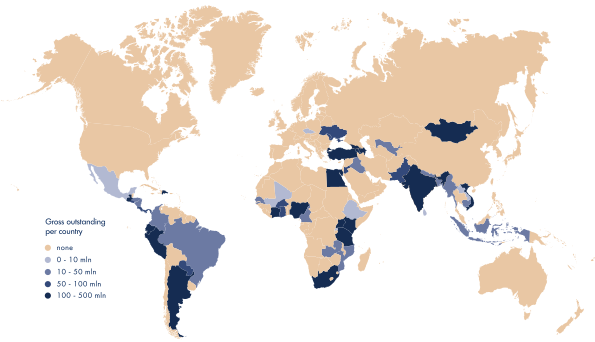
In general, the loan portfolio remains well diversified across different countries. The single largest country exposure represents less than 10 percent of the total loan book. The three largest country exposures in the loan book at the end of 2025 were Türkiye, Georgia, and India, together accounting for around 19 percent of the total loan exposure. In 2025, Türkiye remained at F13, Georgia at F12, and India at F10, with no rating changes during the year.
|
2025 (%) |
2024 (%) |
|
|
F9 and higher (BBB and higher ratings) |
4.7 |
4.6 |
|
F10 (BBB-) |
10.7 |
8.8 |
|
F11 (BB+) |
7.1 |
3.8 |
|
F12 (BB) |
19.9 |
11.9 |
|
F13 (BB-) |
13.7 |
23.2 |
|
F14 (B+) |
16.8 |
9.2 |
|
F15 (B) |
6.4 |
10.9 |
|
F16 (B-) |
11.9 |
16.4 |
|
F17-F19 (CCC+,CCC-, CCC) |
8.8 |
10.2 |
|
F20 (CC) |
0.0 |
1.0 |
|
Total |
100.0 |
100.0 |
In addition to country risk limits, FMO has limits to ensure adequate diversification across sectors and regions. At year‑end 2025, all exposures were within the applicable limits. An overview of the gross exposure of loans distributed by region and sector is given below.
|
Gross amount of loans distributed by region and sector (€ x 1,000) |
||||||
|
Financial Institutions |
Energy |
Agribusiness, Food & Forestry |
Multi-Sector Fund Investments |
Infrastructure, Manufacturing, Services |
Total |
|
|
December 31, 2025 |
||||||
|
Africa |
745,970 |
578,476 |
162,708 |
17,554 |
30,094 |
1,534,802 |
|
Asia |
820,417 |
283,222 |
116,159 |
- |
44,331 |
1,264,129 |
|
Latin America & the Caribbean |
957,348 |
424,618 |
256,640 |
- |
3,339 |
1,641,945 |
|
Europe & Central Asia |
1,185,432 |
144,404 |
285,572 |
- |
46,292 |
1,661,700 |
|
Non-region specific |
77,287 |
121,549 |
269,776 |
- |
- |
468,612 |
|
Total |
3,786,454 |
1,552,269 |
1,090,855 |
17,554 |
124,056 |
6,571,188 |
|
Financial Institutions |
Energy |
Agribusiness, Food & Forestry |
Multi-Sector Fund Investments |
Infrastructure, Manufacturing, Services |
Total |
|
|
December 31, 2024 |
||||||
|
Africa |
695,284 |
650,977 |
175,453 |
29,598 |
76,824 |
1,628,136 |
|
Asia |
722,162 |
284,860 |
120,970 |
- |
51,439 |
1,179,431 |
|
Latin America & the Caribbean |
944,900 |
439,723 |
270,313 |
- |
11,972 |
1,666,908 |
|
Europe & Central Asia |
871,354 |
201,861 |
238,982 |
- |
52,938 |
1,365,135 |
|
Non-region specific |
42,058 |
11,274 |
242,148 |
- |
- |
295,480 |
|
Total |
3,275,758 |
1,588,695 |
1,047,866 |
29,598 |
193,173 |
6,135,090 |
Single risk exposures
Single risk refers to an individual customer or group of customers which are so interconnected that while they might be separate legal entities on paper, from a risk perspective, they behave as if they are a single entity. A single risk exposure refers to the sum of all exposures on entities that constitute a single risk.
FMO has set internal single risk limits at the level that the maximum possible loss for one customer is limited to approximately one year of FMO’s net historical profit. This has resulted in a nominal single risk limit of 6 percent of shareholders’ equity. Given their strategic importance, FMO applies higher Single Risk Limits of 10 percent for Arise B.V. and 8 percent for TCX Investment Management Company B.V. In addition, temporary limits of €325 million for TBC and €331 million for AMEA Power have been approved. Nevertheless, these limits are still well below the CRD IV restriction of 25percent of Regulatory Capital. At year‑end 2025, all exposures were within the applicable limits.
Counterparty credit risk
Definition
The Treasury portfolio is defined as the set of investments, derivative transactions, and cash management activities handled by the Treasury function to manage liquidity and interest rate risks, including government funds and fronting arrangements for syndicated loans. Counterparty credit risk in the treasury portfolio is the risk that FMO will suffer economic losses because a counterparty fails to fulfill its financial or other contractual obligations from open positions in the portfolio.
Risk appetite and governance
The main responsibility of FMO’s Treasury department is to fund FMO’s core business, manage the interest rate and foreign‑exchange risk of the loan portfolio, and manage liquidity within FMO’s risk appetite. The Treasury department’s portfolio consists of high‑quality liquid assets that form the liquidity buffer enabling FMO to meet its liquidity needs under both normal and stressed circumstances. The derivatives portfolio aims to hedge interest rate risk and foreign‑exchange risk. Counterparty risk arising from derivatives is mitigated through collateral arrangements, ensuring that the net exposure to each derivatives counterparty remains within approved limits. The Treasury department does not have its own trading book and does not actively take open positions in the pursuit of profits. FMO aims to balance between keeping losses within its limited risk tolerance and supporting FMO's business strategy, thereby minimizing credit risk and concentration risk in the treasury portfolio, derivative portfolio, and several bank accounts.
The Treasury department is responsible for day-to-day counterparty risk management. The Risk department is the second line and responsible for assessing, quantifying, and monitoring counterparty risk daily. Limit excesses and material findings are reported to the FRC on a monthly basis, together with recommended mitigations and actions. The Risk department is also responsible for updating policies and processes, and for setting limits, including minimum credit rating requirements, exposure limits, and transaction limits. The policies, processes, relevant parameters, and limits are reviewed and approved by the FRC periodically.
At year‑end 2025, all exposures were within the applicable limits.
Developments
Macroeconomic developments continued to influence the broader counterparty landscape, particularly through currency movements and rating actions across Europe. The euro appreciated notably against the US dollar during parts of the year, easing imported inflation pressures and supporting European bank funding conditions. At the same time, the downgrade of France’s sovereign rating led to rating adjustments for several French financial institutions, modestly tightening available counterparty headroom under FMO’s minimum rating thresholds. Nevertheless, FMO’s treasury exposures remained primarily concentrated with high‑quality, strongly rated counterparties, and no material deterioration was observed across the broader counterparty set.
In 2025, counterparty credit risk remained within FMO’s risk appetite, supported by daily monitoring performed by OPS Treasury and prompt notifications of any limit excesses. OPS Treasury provided same‑day updates to Risk on exposure movements and emerging issues, enabling timely assessment and remediation. Monthly independent reviews performed by the Risk department confirmed that treasury exposures and limit utilizations remained in line with policy requirements and were reported to the FRC. A minor limit exceedance during the year was addressed promptly and did not signal any structural weaknesses in counterparty quality.
As part of liquidity planning efforts for 2026, internal work progressed on the governance and limit framework for potential investment in covered bonds. FMO defined the relevant limit structures within the finance kit and obtained the required committee approvals to ensure that any future use of covered bonds aligns with FMO’s conservative credit stance. Given that covered bonds typically carry strong credit ratings and robust structural protections, this preparatory work enhances future optionality while maintaining a prudent counterparty risk profile.
Exposures
Counterparty risk exposures in FMO’s treasury portfolios originate from short-term investments (deposits, investment in money market funds, commercial papers, and collaterals related to transacted derivatives), interest-bearing securities (e.g., bonds), and transacted derivatives for hedging purpose. The tables below show outstanding positions as of December 31, 2025.
|
Overview interest-bearing securities based on rating scale S&P and Fitch (€ x 1,000) |
||
|
2025 |
2024 |
|
|
AAA |
193,276 |
262,438 |
|
AA- to AA+ |
304,194 |
315,028 |
|
A+ |
198,852 |
- |
|
BBB- |
10,968 |
11,928 |
|
Total |
707,290 |
589,394 |
|
Geographical distribution interest-bearing securities |
||
|
2025 (%) |
2024 (%) |
|
|
Belgium |
4 |
4 |
|
Finland |
7 |
11 |
|
France |
18 |
20 |
|
Germany |
25 |
17 |
|
The Netherlands |
5 |
11 |
|
Slovenia |
3 |
- |
|
Sweden |
7 |
11 |
|
Denmark |
7 |
4 |
|
India |
1 |
2 |
|
Luxembourg |
6 |
2 |
|
South Korea |
4 |
4 |
|
Supra-nationals* |
13 |
14 |
|
Total |
100 |
100 |
|
Overview short-term deposits based on rating scale S&P (€ x 1,000) |
||
|
2025 |
2024 |
|
|
European Central Bank |
2,946 |
2,946 |
|
Dutch central bank |
524,818 |
710,956 |
|
Financial Institutions |
||
|
A-1/A-1+ |
365,863 |
598,151 |
|
A-2 |
- |
23,820 |
|
Money Market Funds |
||
|
A-1+ |
176,498 |
145,494 |
|
Total at December 31 2025 |
1,070,125 |
1,481,367 |
FMO mitigates its counterparty credit risk through various means. Minimum requirements of credit quality are set for counterparties of treasury activities. Netting and collateral agreements are also utilized to reduce counterparty credit risk originating from derivative transactions. FMO has Credit Support Annexes (CSAs) with all derivative counterparties. Additionally, part of the derivative portfolio, particularly EUR and USD interest rate swaps, is cleared through central counterparties, as required by the European Market Infrastructure Regulations.
|
Derivative financial instruments distributed by rating, based on rating scale S&P and Fitch (€ x 1,000) |
||||
|
2025 |
2024 |
|||
|
Net exposure |
CSA (%) |
Net exposure |
CSA (%) |
|
|
AA- to AA+ |
83,916 |
100 |
7,352 |
100 |
|
A- to A+ |
144,670 |
100 |
107,765 |
100 |
|
BBB to BBB+ |
- |
- |
- |
- |
|
Central cleared |
- |
- |
- |
- |
|
Total |
228,586 |
100 |
115,117 |
100 |
The table above presents only derivative positions with a positive market value, shown on a net basis per counterparty. Gross derivative assets of €228.6 million and liabilities of €126.7 million net to a positive exposure of approximately €101.9 million.
The tables below include derivative financial assets and derivative financial liabilities that:
-
Are offset in the consolidated balance sheet of FMO; or
-
Are subject to an enforceable master netting arrangement or similar agreement that covers similar financial instruments, irrespective of whether they are offset in the consolidated balance sheet.
FMO receives and pledges only cash collateral with respect to derivatives.
|
2025 |
||||
|
(€ x 1,000) |
Derivatives financial assets |
Derivatives financial liabilities |
Total |
|
|
Gross amounts recognized in balance sheet |
(a) |
233,483 |
143,989 |
89,494 |
|
Gross amount of financial assets/liabilities offset in the balance sheet |
(b) |
- |
- |
- |
|
Net amount presented in the balance sheet |
(c)=(a)-(b) |
233,483 |
143,989 |
89,494 |
|
Related amounts not offset in the balance sheet |
||||
|
Financial instruments (including non-cash collateral) |
(d) |
- |
- |
- |
|
Cash collateral |
(d) |
- |
- |
-61,631 |
|
Net amount |
(e)=(c)+(d) |
233,483 |
143,989 |
27,863 |
|
2024 |
||||
|
(€ x 1,000) |
Derivatives financial assets |
Derivatives financial liabilities |
Total |
|
|
Gross amounts recognized in balance sheet |
(a) |
126,339 |
471,386 |
-345,047 |
|
Gross amount of financial assets/liabilities offset in the balance sheet |
(b) |
- |
- |
- |
|
Net amount presented in the balance sheet |
(c)=(a)-(b) |
126,339 |
471,386 |
-345,047 |
|
Related amounts not offset in the balance sheet |
||||
|
Financial instruments (including non-cash collateral) |
(d) |
- |
- |
- |
|
Cash collateral |
(d) |
- |
- |
364,147 |
|
Net amount |
(e)=(c)+(d) |
126,339 |
471,386 |
19,100 |
Liquidity risk
Definition
Liquidity risk is defined as the risk of FMO not being able to fulfill its financial obligations due to insufficient availability of liquid means.
Risk appetite and governance
FMO’s risk appetite is to maintain adequate liquidity buffers to fulfill FMO’s current and future financial obligations at all times. The appetite follows a similar rationale as for capital and is aimed at maintaining enough liquidity to ensure FMO would never need to fall back on the guarantee provided by the Dutch Government to FMO's investors. To realize this ambition, minimum liquidity requirements apply as prescribed by the regulator.
FMO’s liquidity risk policy framework is built on four pillars:
-
Survival period and minimum liquidity buffer under stress;
-
Maturity matched funding;
-
Diversified funding; and
-
Regulatory ratio requirements.
FMO’s risk appetite levels are defined to ensure a minimum buffer above the seven month minimum survival period under stress, a Liquidity Coverage Ratio (LCR) above 135 percent, a Net Stable Funding Ratio (NSFR) above 107 percent, and restrictions on failed funding periods and cost of wholesale funding compared to peers. Additional thresholds such as matching funding, funding diversification and liquidity in specific currencies, are also in place for managing and monitoring the risk profile of the bank. These monitoring metrics are delegated to the Director Risk and the Director Treasury and are subject to a formal sign- off procedure and reported to the FRC. The FRC is also responsible for approving the liquidity risk policy.
FMO has a conservative liquidity policy and funding strategy that is well suited to its business. Stress tests are conducted on FMO’s liquidity position on a weekly basis to ensure this conservative position is maintained. During the Internal Liquidity Adequacy Assessment Process (ILAAP), FMO performs additional stress tests, including scenarios provided by DNB and reverse stress testing. A continuous review is performed on the liquidity position, FMO’s assumptions, internal expectations and external market conditions to ensure that FMO’s liquidity planning is accurate.
The liquidity contingency plan sets out FMO’s strategy for addressing liquidity needs in the case of a crisis, ensuring various sources of emergency liquidity are available to meet all current and future financial obligations, while avoiding excessive funding costs, incurring unacceptable losses or significantly changing the business profile. The liquidity sources include a long-term bond portfolio and a portfolio of short-term instruments such as cash, money market funds, commercial papers, and treasury bills. The long-term bonds and commercial paper can be used as collateral in repurchase agreements to obtain short-term cash from the ECB.
Developments
In 2025, global financial markets continued to adjust to a more accommodative monetary stance as major central banks sought to balance growth and inflation. The European Central Bank (ECB) lowered its deposit facility rate by 100 basis points bringing it to its 2 percent medium-term target, while maintaining a cautious outlook amid trade uncertainty and deflationary pressures in Europe. The U.S. Federal Reserve (FED) cut the federal funds rate by 25 basis points each in September, October, and December 2025, bringing it to the 3.50 percent–3.75 percent range, aiming to support economic activity without reigniting inflation.
EUR appreciated significantly against USD, reversing the trend of the previous year. This appreciation led to considerable collateral inflows from FMO’s derivative positions, which in turn boosted FMO’s liquidity buffers. FMO maintained uninterrupted access to funding markets, reinforcing its reputation as a reliable issuer. Building on its 2024 initiative to launch a commercial paper program, FMO achieved a major milestone in 2025 by obtaining the Short-Term European Paper (STEP) label, making its commercial papers eligible for Eurosystem collateral and enhancing their attractiveness to investors.
Continuing its commitment to developing capital markets in line with its mandate, FMO solidified its position as an established issuer in local currency frontier markets through regular issuance activities. In 2025, FMO issued approximately €522 million in equivalent funding through 25 transactions in 13 local currencies. These efforts not only reinforced FMO's presence in these markets but also contributed to the overall development and stability of local financial systems.
Liquidity position
FMO's liquidity position remained above regulatory requirements and internal managerial limits in 2025, with an LCR never falling below 239 percent.
The following table shows the categorization of the balance sheet per maturity bucket. This table shows the timing of the undiscounted contractual cash flows (and not the market values) per instrument. The totals per instrument may therefore differ from the totals on the balance sheet. Expected cash flows resulting from irrevocable facilities being drawn are not included in the liquidity gap. For internal liquidity planning and management, cash flows from irrevocable facilities are included in the cash flow forecasts.
It presents contractual cash flows only, as such, does not necessarily reflect FMO’s actual liquidity risk profile. For example, certain assets (such as money market funds and equity investments) do not generate contractual interest cash flows, whereas the funding raised to finance them may do so. FMO manages liquidity risk using an expected‑behavior perspective that incorporates observed and anticipated cash‑flow patterns of assets and liabilities, product features (e.g., prepayments, roll‑overs) and undrawn commitments.
|
2025 |
||||||
|
(€ x 1,000) |
< 3 months |
3-12 months |
1-5 years |
>5 years |
Maturity undefined |
Total |
|
Assets |
||||||
|
Cash balances with Banks |
140,239 |
- |
- |
- |
- |
140,239 |
|
Current accounts with State funds and other programs |
3,207 |
- |
- |
- |
- |
3,207 |
|
Short-term deposits |
1,067,178 |
- |
- |
- |
- |
1,067,178 |
|
-of which: Amortized cost |
621,048 |
- |
- |
- |
- |
621,048 |
|
-of which: Fair value through profit or loss |
446,130 |
- |
- |
- |
- |
446,130 |
|
Other receivables |
33,487 |
- |
- |
- |
- |
33,487 |
|
Interest-bearing securities |
25,235 |
62,947 |
548,419 |
134,030 |
- |
770,631 |
|
-of which: amortized cost |
23,645 |
60,629 |
434,162 |
103,265 |
- |
621,701 |
|
-of which: fair value through profit or loss |
1,590 |
2,317 |
114,257 |
30,765 |
- |
148,929 |
|
Derivative financial instruments |
6,994 |
95,477 |
265,006 |
11,798 |
- |
379,275 |
|
Loans to the private sector |
289,365 |
1,336,215 |
4,015,619 |
2,532,411 |
- |
8,173,610 |
|
-of which: Amortized cost |
274,988 |
1,155,432 |
3,734,334 |
1,986,746 |
- |
7,151,501 |
|
-of which: Fair value through profit or loss |
14,377 |
180,782 |
281,285 |
545,665 |
- |
1,022,110 |
|
Equity investments |
- |
- |
- |
- |
2,389,610 |
2,389,610 |
|
-of which: Fair value through OCI |
- |
- |
- |
- |
223,452 |
223,452 |
|
-of which: Fair value through profit or loss |
- |
- |
- |
- |
2,166,158 |
2,166,158 |
|
Investments in associates |
- |
- |
- |
- |
386,603 |
386,603 |
|
Total financial assets |
1,565,706 |
1,494,638 |
4,829,044 |
2,678,239 |
2,776,213 |
13,343,840 |
|
Liabilities and shareholders’ equity |
- |
|||||
|
Short-term credits |
307,861 |
240,000 |
- |
- |
- |
547,861 |
|
Current accounts with State funds and other programs |
2,117 |
- |
- |
- |
- |
2,117 |
|
Derivative financial instruments |
14,964 |
37,790 |
-27,759 |
-30,659 |
- |
-5,664 |
|
Debentures and notes |
321,537 |
1,097,344 |
4,441,503 |
1,217,866 |
- |
7,078,251 |
|
Dutch government program liabilities |
- |
- |
- |
- |
96,887 |
96,887 |
|
-of which: Fair value through profit or loss |
- |
- |
- |
- |
96,887 |
96,887 |
|
Accrued and other liabilities |
147,056 |
1,911 |
9,470 |
23,155 |
- |
181,592 |
|
Shareholders’ equity |
- |
- |
- |
- |
3,861,951 |
3,861,951 |
|
Total financial Liabilities and shareholder's equity |
793,536 |
1,377,045 |
4,423,214 |
1,210,363 |
3,958,838 |
11,859,882 |
|
Liquidity surplus/(gap) 2025 |
772,170 |
117,593 |
405,831 |
1,467,876 |
-1,182,625 |
1,483,958 |
|
2024 |
||||||
|
(€ x 1,000) |
< 3 months |
3-12 months |
1-5 years |
>5 years |
Maturity undefined |
Total |
|
Assets |
||||||
|
Cash balances with Banks |
43,087 |
- |
- |
- |
- |
43,087 |
|
Current accounts with State funds and other programs |
- |
1,336 |
- |
- |
- |
1,336 |
|
Short-term deposits |
1,081,315 |
16,715 |
- |
- |
- |
1,482,218 |
|
-of which: Amortized cost |
1,095,203 |
16,715 |
- |
- |
- |
1,111,918 |
|
-of which: Fair value through profit or loss |
370,300 |
- |
- |
- |
- |
370,300 |
|
Other receivables |
18,393 |
- |
- |
- |
- |
18,393 |
|
Interest-bearing securities |
22,288 |
156,105 |
350,661 |
98,345 |
- |
627,399 |
|
-of which: amortized cost |
20,698 |
154,817 |
264,151 |
66,815 |
- |
506,482 |
|
-of which: fair value through profit or loss |
1,590 |
1,288 |
86,510 |
31,530 |
- |
120,918 |
|
Derivative financial instruments |
5,377 |
-23,936 |
-30,469 |
-12,349 |
- |
-61,378 |
|
Loans to the private sector |
334,466 |
1,457,267 |
4,384,435 |
1,573,791 |
- |
7,749,959 |
|
-of which: Amortized cost |
277,942 |
1,356,241 |
3,996,038 |
1,246,415 |
- |
6,876,637 |
|
-of which: Fair value through profit or loss |
56,524 |
101,026 |
388,397 |
327,376 |
- |
873,322 |
|
Equity investments |
- |
- |
- |
- |
2,556,913 |
2,556,913 |
|
-of which: Fair value through OCI |
- |
- |
- |
- |
201,287 |
201,287 |
|
-of which: Fair value through profit or loss |
- |
- |
- |
- |
2,355,626 |
2,355,626 |
|
Investments in associates |
- |
- |
- |
- |
372,073 |
372,073 |
|
Total financial assets |
1,504,926 |
1,607,487 |
4,704,626 |
1,659,787 |
2,928,986 |
12,790,000 |
|
Liabilities and shareholders’ equity |
- |
|||||
|
Short-term credits |
217,100 |
- |
- |
- |
- |
217,100 |
|
Current accounts with State funds and other programs |
93 |
- |
- |
- |
- |
93 |
|
Derivative financial instruments |
-5,303 |
-31,144 |
86,549 |
15,692 |
- |
65,794 |
|
Debentures and notes |
76,548 |
1,590,055 |
5,159,321 |
124,929 |
- |
6,950,853 |
|
Dutch government program liabilities |
- |
|||||
|
-of which: Fair value through profit or loss |
- |
- |
- |
- |
121,715 |
121,715 |
|
Accrued and other liabilities |
39,532 |
2,291 |
7,973 |
18 |
7,792 |
57,606 |
|
Shareholders’ equity |
- |
- |
- |
- |
3,855,680 |
3,855,680 |
|
Total financial Liabilities and shareholder's equity |
327,970 |
1,561,202 |
5,253,842 |
140,639 |
3,985,187 |
11,268,841 |
|
Liquidity surplus/(gap) 2024 |
1,176,956 |
46,285 |
-549,216 |
1,519,148 |
-1,056,201 |
1,521,159 |
The tables below are based on the final availability date of the contingent liabilities and irrevocable facilities.
|
Contractual maturity of effective guarantees issued and irrevocable facilities (€ x 1,000) |
|||||
|
December 31, 2025 |
< 3 months |
3-12 months |
1-5 years |
>5 years |
Total |
|
Effective guarantees issued |
- |
15,499 |
68,122 |
135,092 |
218,713 |
|
Irrevocable facilities |
- |
31,539 |
251,334 |
1,646,900 |
1,929,773 |
|
Total off-balance |
- |
47,038 |
319,456 |
1,781,992 |
2,148,486 |
|
Contractual maturity of effective guarantees issued and irrevocable facilities (€ x 1,000) |
|||||
|
December 31, 2024 |
< 3 months |
3-12 months |
1-5 years |
>5 years |
Total |
|
Effective guarantees issued |
- |
23,996 |
48,726 |
120,454 |
193,176 |
|
Irrevocable facilities |
- |
67,771 |
199,730 |
1,899,758 |
2,167,259 |
|
Total off-balance |
- |
91,767 |
248,456 |
2,020,212 |
2,360,435 |
FMO expects that not all of these off-balance items will be drawn before expiration date.
FMO complies with DNB’s Pillar 2 liquidity requirements methodology for Less Significant Institutions (LSIs), which have been applied from the Supervisory Review and Evaluation Process (SREP). The liquidity requirements are a survival period of at least six months based on internal stress testing methodology, a Net Stable Funding Ratio (NSFR) of 100 percent and a specific Liquidity Coverage Ratio (LCR) requirement of 100 percent. FMO's internal liquidity appetite levels include a safety cushion over and above the minimum requirements as described in the section above.
FMO's liquidity position has been above regulatory requirements and internal risk appetite levels throughout 2025. Per the reporting date, FMO has a survival period exceeding 7 months, an LCR of 368 percent (2024: 428 percent) and a NSFR of 111 percent (2024: 108 percent).
FMO’s major liquidity exposures are in EUR and USD currencies. However, some transactions are denominated, and may be settled, in local currencies. These exposures are specifically hedged using financial instruments to minimize liquidity and settlement risks.
Funding and sustainability bonds
The Treasury department aims to ensure good market access by diversifying FMO’s funding sources. The result of this is a balanced funding mix in terms of currency, instrument and maturity.
Eurodollar (e.g. USD investors outside the United States) constitutes a key market for FMO. The Treasury department has identified USD and EUR as strategic funding markets. Other markets to attract funding include Australia, Sweden, UK, Japan and local frontier currencies. Except for our Tier II issuance, FMO funding is plain vanilla and generally senior unsecured funding.
ESG bonds are an important part of FMO’s funding strategy and accounted for about 50 percent of the funding portfolio in 2025. Updated in 2025, The Sustainability Bond Framework reflects FMO’s internal processes and strategy regarding ESG as well as detailed Green and Social eligible categories. The Framework has been externally reviewed by S&P Global Ratings. In its 2025 update, FMO aimed to align its Bond Framework with the latest internal and external developments. The Framework allows FMO to issue i) Green; ii) Social; and iii) Sustainability Bonds. In October 2025, FMO priced a EUR 500 million 5-Year Inaugural Social Bond, which is seeking to widen access to financial services and contribute to economic development by improving access to food and energy, and directly aligned with the goal of Reducing Inequalities (SDG 10).
Market risk
Market Risk is the risk that the value and/or earnings of the bank decline because of unfavorable market movements. At FMO, this includes interest rate risk (including credit spread risk) and currency risk.
Interest rate risk in the banking book
Definition
Interest rate risk is the risk of potential loss due to adverse movements in interest rates. Changes to interest rates mainly influence the fair value of fixed interest balance sheet items and affect the bank’s earnings by altering interest rate-sensitive income and expenses, affecting its Net Interest Income (NII).
Credit spread risk is the risk driven by changes to the market price for credit risk, for liquidity, and potentially for other characteristics of credit-risky instruments, which is not captured by any another existing prudential framework, such as IRRBB or by expected credit/(jump-to) default risk.
Risk appetite and governance
FMO has no trading book, and all assets (loans and investments) are part of the banking book. FMO’s policy is to match assets and liabilities within defined limits. As the loan portfolio is more granular, loans are pre-funded and new funding is obtained periodically and matched to the asset portfolio in terms of expected maturity and interest rate sensitivity. Interest rate risk arises from the residual tenor mismatch, mismatch in fixed rate assets funded by floating rate liabilities, and differences in reference rates or currencies resulting in basis risk. FMO has little optionality in its portfolio and no material exposure to rates-driven prepayment risk.
Interest rate risk management falls under the responsibility of the FRC. The Treasury department acts as the first line and is responsible for the day-to-day management of interest rate risk and daily transactions. The quantification, monitoring and control of market risk is the responsibility of the Risk department as the second line.
FMO considers the securities held in the liquidity buffer, assets accounted at fair value and amortized cost and the funding portfolio as the main balance sheet items sensitive to credit spread risk. For liabilities, credit spread risk would relate to FMO’s own credit risk.
Interest rate risk is monitored using earnings-based metrics and value-based metrics.
Earnings-based methods capture short-term effects of interest rate refixing or repricing that may impact NII. The following two metrics are used for this purpose:
-
The interest rate gap provides a static overview of the full balance sheet’s repricing and refinancing characteristics. The gap is monitored over different horizons on a cumulative level, for all currencies (aggregate and currency-by-currency).
-
NII at Risk provides a projection of net interest income sensitivity to yield curve shocks. FMO monitors NII at Risk on a one-year forward-looking basis and applies different scenarios simultaneously that also allow for identification of basis risk.
Economic value methods capture the effects of yield-curve changes. Value-based metrics measure the long-term effects of interest rate changes over the full tenor of the balance sheet. The following economic value metrics are calculated:
-
Basis Point Value (BPV) provides the change in market value of assets, liabilities and interest-rate risk sensitive off-balance items for a one basis point change in yield curves. Limits are in place for the whole balance sheet, and main currencies (EUR and USD) separately.
-
Delta Economic Value of Equity (delta EVE) provides changes in the economic value of the shareholder’s equity, given certain shifts in yield curves.
The interest rate gap and BPV exposure are monitored on a weekly basis against limits set by the FRC. BPV limits are defined dynamically to accommodate a 200 basis-points shock within five percent of Tier I. The delta EVE limit is defined in the Risk Appetite Framework (RAF) and set at five percent of Tier I. The NII at Risk limit is defined based on one percent of Tier 1.
Credit spread risk is measured under both economic value and NII, in line with IRRBB.
The interest rate positions were within risk appetite in 2025.
Developments
No material developments occurred in 2025. FMO's positions remained well within the limits.
Exposures
Basis point value (BPV) is the loss in economic value of equity as a result of a one basis point change in the yield curve. The impact is calculated for cash flows from all interest-bearing assets, liabilities and off-balance sheet items in the banking book under an assumption of a run-off balance sheet. The metric is calculated by discounting projected cash flows (including commercial margins and other spread components). Credit spreads are included in the discount curves for internal management purposes.
On December 31, 2025 the scenario with the highest impact is the scenario where interest rates increase by instantaneously.
NII-at-Risk is the difference in NII between a base scenario and an alternative scenario observed over a 1‑year horizon. NII-at-Risk is calculated for a 200bps instantaneous increase in interest rates (parallel move up) and for a 200bps instantaneous decrease in interest rates (parallel move down). NII-at-Risk includes all expected cash flows, including commercial margins and other spread components, from all interest rate‑sensitive assets, liabilities and off-balance sheet items in the banking book. The NII-at-Risk assumes a constant balance sheet.
On December 31, 2025, the NII-at-Risk was EUR 2 million for the scenario where there is an instantaneous increase in interest rates of 200bps, and EUR 2 million negative for the scenario where there is an instantaneous decrease in interest rates of 200bps.
The following table summarizes the sensitivities to interest rate movements.
|
Interest rate risk sensitivities (€ x 1,000) |
||
|
December 31, 2025 |
December 31, 2024 |
|
|
BPV, 1 bps instantaneous increase in interest rates |
-226 |
-83 |
|
BPV, 1 bps instantaneous decrease in interest rates |
226 |
83 |
|
NII at Risk 1 year, 200 instantaneous increase in interest rates |
2,034 |
8,222 |
|
NII at Risk 1 year, 200 instantaneous decrease in interest rates |
-2,066 |
-8,830 |
|
based on material currencies (EUR and USD) |
||
|
NII at Risk based on a constant balance sheet assumption |
||
Currency risk
Definition
Currency risk is defined as the risk of changes in foreign currency exchange rates having an adverse effect on the value of FMO’s financial position and future cash flows. FMO also reviews currency risk in terms of impact on capital ratios.
Risk appetite and governance
FMO’s appetite for market risk (including currency risk) is cautious and direct currency risk is largely hedged to remain within conservative boundaries. Currency risk management falls under the responsibility of the FRC. The Treasury department acts as the first line and is responsible for the day-to-day management of currency risk and daily transactions. The quantification, monitoring and control of currency risk is the responsibility of the Risk department as the second line. Exposures are hedged through matching currency characteristics of assets with liabilities, or through derivative transactions such as cross-currency swaps and FX forwards conducted with either commercial parties or The Currency Exchange Fund (TCX Fund). Most currency exposures are micro-hedged to USD, with the USD position managed on a portfolio basis. FMO does not take active positions in any currency for the purposes of making a profit. Each individual currency is managed within a strict position limit, and an overall appetite level is set at 1 percent of shareholders' equity for the total open position across all currencies. Additionally, FMO deliberately maintains an unhedged foreign currency position in equity investments (this position is not included in position limits and in 1 percent of shareholders' equity limit) in order to manage the volatility of the capital ratio. By managing a structural open currency position, FMO can stabilize the capital ratio, but simultaneously increases the sensitivity of P&L (and thus shareholders’ equity) towards currency movements. Individual and total open currency positions were within risk appetite during 2025.
Developments
No material developments occurred in 2025. FMO's positions remained well within the limits.
Exposures
Individual and total open currency positions were within risk appetite in 2025. The table below (based on significant currencies) illustrates that the currency risk sensitivity gap as of December 2025 was almost completely part of FMO's equity investments and investments in associates and mainly in USD.
|
2025 |
||||||
|
(€ x 1,000) |
EUR |
USD |
INR |
UZS |
Other |
Total |
|
Assets |
||||||
|
Cash balances with Banks |
52,664 |
83,556 |
162 |
- |
3,857 |
140,239 |
|
Current accounts with State funds and other programs |
1,376 |
1,840 |
- |
- |
-9 |
3,207 |
|
Short-term deposits |
||||||
|
-of which: Amortized cost |
623,995 |
- |
- |
- |
- |
623,995 |
|
-of which: Fair value through profit or loss |
99,636 |
346,494 |
- |
- |
- |
446,130 |
|
Other receivables |
20,551 |
11,918 |
-75 |
- |
1,093 |
33,487 |
|
Interest-bearing securities |
||||||
|
-of which: amortized cost |
525,973 |
36,229 |
10,968 |
- |
- |
573,170 |
|
-of which: fair value through profit or loss |
107,636 |
26,484 |
- |
- |
- |
134,120 |
|
Derivative financial instruments |
807,906 |
-835,058 |
-319,320 |
1,766 |
578,188 |
233,483 |
|
Loans to the private sector |
||||||
|
-of which: Amortized cost |
632,594 |
3,714,674 |
388,324 |
164,188 |
704,836 |
5,604,615 |
|
-of which: Fair value through profit or loss |
153,285 |
541,685 |
- |
- |
14,730 |
709,700 |
|
Equity investments |
||||||
|
-of which: Fair value through OCI |
9,139 |
214,313 |
- |
- |
- |
223,452 |
|
-of which: Fair value through profit or loss |
459,693 |
1,441,630 |
115,625 |
63,363 |
85,847 |
2,166,158 |
|
Investments in associates and joint ventures |
2,051 |
384,552 |
- |
- |
- |
386,603 |
|
Current tax receivables |
876 |
11 |
- |
- |
6 |
893 |
|
Property, plant and equipment |
31,387 |
16 |
- |
- |
- |
31,403 |
|
Intangible assets |
37,883 |
- |
- |
- |
- |
37,883 |
|
Deferred income tax assets |
3,647 |
- |
- |
- |
- |
3,647 |
|
Total assets |
3,570,292 |
5,968,344 |
195,684 |
229,317 |
1,388,548 |
11,352,185 |
|
Liabilities and shareholders’ equity |
||||||
|
Short-term credits |
496,540 |
46,146 |
- |
- |
1,279 |
543,965 |
|
Current accounts with State funds and other programs |
881 |
1,290 |
- |
- |
-54 |
2,117 |
|
Derivative financial instruments1 |
-682,388 |
901,117 |
94,852 |
135,931 |
-305,523 |
143,989 |
|
Dutch government program liabilities |
- |
- |
- |
- |
- |
- |
|
-of which: Fair value through profit or loss |
92,514 |
4,373 |
- |
- |
- |
96,887 |
|
Debentures and notes |
1,899,303 |
2,924,788 |
- |
36,714 |
1,638,087 |
6,498,892 |
|
Accrued and other liabilities |
76,035 |
93,742 |
2,961 |
15 |
1,410 |
174,163 |
|
Provisions |
18,053 |
11,883 |
- |
- |
6 |
29,942 |
|
Deferred income tax liabilities |
279 |
- |
- |
- |
- |
279 |
|
Shareholders’ equity |
3,861,951 |
- |
- |
- |
- |
3,861,951 |
|
Total liabilities and shareholders’ equity |
5,763,168 |
3,983,339 |
97,813 |
172,660 |
1,335,205 |
11,352,185 |
|
Currency gap 2025 |
1,985,005 |
97,871 |
56,657 |
53,343 |
||
|
Currency gap 2025 excluding equity investments, investments in associates and Dutch government program liabilities |
-51,117 |
-17,754 |
-6,706 |
-32,504 |
||
|
2024 |
||||||
|
(€ x 1,000) |
EUR |
USD |
INR |
ZAR |
Other |
Total |
|
Assets |
||||||
|
Cash balances with Banks |
23,981 |
14,913 |
247 |
- |
3,946 |
43,087 |
|
Current accounts with State funds and other programs |
633 |
622 |
- |
- |
81 |
1,336 |
|
Short-term deposits |
||||||
|
-of which: Amortized cost |
1,067,099 |
40,901 |
- |
- |
3,886 |
1,111,886 |
|
-of which: Fair value through profit or loss |
8,030 |
361,451 |
- |
- |
- |
369,481 |
|
Other receivables |
3,177 |
14,350 |
-90 |
- |
956 |
18,393 |
|
Interest-bearing securities |
||||||
|
-of which: amortized cost |
345,763 |
124,107 |
11,928 |
- |
- |
481,798 |
|
-of which: fair value through profit or loss |
107,596 |
- |
- |
- |
- |
107,596 |
|
Derivative financial instruments |
-174,782 |
791,731 |
-376,312 |
-94,374 |
-19,924 |
126,339 |
|
Loans to the private sector |
||||||
|
-of which: Amortized cost |
471,716 |
3,780,368 |
359,408 |
121,503 |
457,523 |
5,190,518 |
|
-of which: Fair value through profit or loss |
107,891 |
530,604 |
- |
- |
13,566 |
652,061 |
|
Equity investments |
||||||
|
-of which: Fair value through OCI |
10,072 |
191,215 |
- |
- |
- |
201,287 |
|
-of which: Fair value through profit or loss |
479,818 |
1,635,225 |
102,215 |
49,076 |
89,292 |
2,355,626 |
|
Investments in associates and joint ventures |
2,494 |
369,579 |
- |
- |
- |
372,073 |
|
Current tax receivables |
13,253 |
39 |
- |
- |
5 |
13,297 |
|
Property, plant and equipment |
16,336 |
29 |
- |
- |
- |
16,365 |
|
Intangible assets |
26,445 |
- |
- |
- |
- |
26,445 |
|
Deferred income tax assets |
9,075 |
- |
- |
- |
- |
9,075 |
|
Total assets |
2,518,597 |
7,855,134 |
97,396 |
76,205 |
549,331 |
11,096,663 |
|
Liabilities and shareholders’ equity |
||||||
|
Short-term credits |
216,912 |
- |
- |
- |
- |
216,912 |
|
Current accounts with State funds and other programs |
93 |
- |
- |
- |
- |
93 |
|
Derivative financial instruments1 |
-583,027 |
2,128,526 |
8,736 |
-33,011 |
-1,049,838 |
471,386 |
|
Dutch government program liabilities |
||||||
|
-of which: Fair value through profit or loss |
119,370 |
2,345 |
- |
- |
- |
121,715 |
|
Debentures and notes |
1,241,501 |
3,494,656 |
- |
64,230 |
1,535,594 |
6,335,981 |
|
Accrued and other liabilities |
42,117 |
16,591 |
- |
15 |
1,501 |
60,224 |
|
Provisions |
24,060 |
11,234 |
- |
- |
1,486 |
36,780 |
|
Deferred income tax liabilities |
510 |
- |
- |
- |
- |
510 |
|
Shareholders’ equity |
3,854,681 |
992 |
- |
- |
7 |
3,855,680 |
|
Total liabilities and shareholders’ equity |
4,916,217 |
5,654,344 |
8,736 |
31,234 |
488,750 |
11,096,663 |
|
Currency gap 2024 |
2,200,790 |
88,660 |
44,971 |
60,581 |
||
|
Currency gap 2024 excluding equity investments and investments in associates |
4,770 |
-13,554 |
-4,105 |
-28,711 |
||
As described above, FMO’s loan assets in local currencies, such as the Indian Rupee (INR), are fully swapped to the US Dollar on a cash flow basis. The positions in these currencies are therefore fully hedged. For IFRS reporting, however, the loans are recorded at (amortized) cost, while the related swaps are recorded at fair value, leading to an accounting mismatch in these currencies.
|
Sensitivity of profit & loss account and shareholders’ equity to main foreign currencies (€ x 1,000) |
||
|
December 31, 2025 |
||
|
Change of value relative to the euro |
Sensitivity of profit & loss account |
Sensitivity of shareholders’ equity |
|
USD value increase of 10% |
177,069 |
21,431 |
|
USD value decrease of 10% |
-177,069 |
-21,431 |
|
- |
- |
|
|
INR value increase of 10% |
9,787 |
- |
|
INR value decrease of 10% |
-9,787 |
- |
|
- |
- |
|
|
UZS value increase of 10% |
5,666 |
- |
|
UZS value decrease of 10% |
-5,666 |
- |
|
Sensitivity of profit & loss account and shareholders’ equity to main foreign currencies (€ x 1,000) |
||
|
December 31, 2024 |
||
|
Change of value relative to the euro |
Sensitivity of profit & loss account |
Sensitivity of shareholders’ equity |
|
USD value increase of 10% |
200,957 |
19,122 |
|
USD value decrease of 10% |
-200,957 |
-19,122 |
|
INR value increase of 10% |
8,866 |
- |
|
INR value decrease of 10% |
-8,866 |
- |
|
ZAR value increase of 10% |
4,497 |
- |
|
ZAR value decrease of 10% |
-4,497 |
- |
The sensitivities employ simplified scenarios. The sensitivity of profit and loss account and shareholders’ equity to possible changes in the main foreign currencies is based on the immediate impact on the financial assets and liabilities held at year-end. This includes the effect of hedging instruments.
Shareholders’ equity is sensitive to equity investments valued at fair value through other comprehensive income.
Structural hedge
The structural hedge is an FX strategy which aims at stabilizing the capital ratios from FX volatility. FMO deliberately maintains long open FX positions to (partially) hedge against an adverse effect of FX rates on its capital ratios. For example, a depreciation of FMO's reporting currency (EUR) will, on one side, generate a profit that will increase FMO’s own funds and, on the other side, increase the risk weighted assets in euro equivalent. The first effect will increase the capital ratios while the second one will decrease them. This balancing system stabilizes the capital ratios from FX movements, irrespective of whether that effect derives from an appreciation or a depreciation of that foreign currency with respect to the reporting currency (EUR).